Jewish Heritage in Morocco: Synagogues, Mellahs & Living Memory
From the ancient Berber Jewish tribes of Fes to the Sephardic ports of Tangier, from King Mohammed V's protection of his Jewish subjects during the Holocaust to the only Jewish Museum in the Arab world — a complete guide to Morocco's 2,000-year Jewish history and how to experience it on a private heritage tour.
The Trusted Specialists for Moroccan Jewish Heritage Travel
Most travelers booking a Jewish heritage tour of Morocco have personal stakes — Moroccan-Jewish family roots, a Bar or Bat Mitzvah journey, an ancestor's grave to visit, or a community connection in Israel, France, Canada, or the United States. Generic tour operators handle Morocco well, but they don't know which synagogue caretaker holds the key to the Abensour Synagogue's mikveh, how to coordinate a hosted Shabbat dinner in the Casablanca community, or which Atlas Mountain shrines welcome hillula pilgrims. We do — because most of our heritage clients are exactly like you, and we've been arranging these trips since 1999.
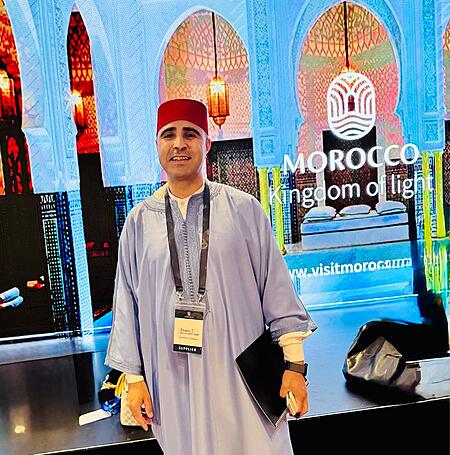
Brahim Jounh — Founder & Heritage Tour Specialist
"I grew up in Morocco where my neighbors, my schoolmates, the goldsmith who made my mother's bracelets — many were Jewish. The 1948–1970s emigration emptied the streets I knew, but the synagogues, the cemeteries, and the family stories never left. When clients arrive whose grandparents grew up in the Fes Mellah or the Marrakech Riad El Berkani, I take that personally. We open synagogues that aren't on the public schedule, we sit with the cemetery caretaker over mint tea, and we arrange the things that matter most — the kosher meal, the hosted Shabbat, the visit to a great-grandparent's grave."
Credentials: Gateway2Morocco Travel Ltd is Canadian-licensed under BPCPA #80460, IATA-accredited, and ACTA-accredited. 4.9★ across 298 verified TripAdvisor reviews. Meet the team →
Moroccan Jewish History: A 2,000-Year Timeline
Morocco has one of the oldest and most distinctive Jewish histories in the world. Communities have lived here since at least Roman times — some scholars argue since the era of Phoenician trade in the second millennium BCE — and the country still hosts the largest Jewish community in the Arab world today, even after the dramatic 20th-century emigration.
Ancient roots & Berber Jewish tribes
Earliest documented Jewish presence in the territory of modern Morocco, attested near Fes by the 2nd century BCE. Amazigh (Berber) tribes of Jewish faith form an autochthonous nucleus, later reinforced by migrants dispersing across the Mediterranean after the destruction of the Second Temple. Ancient tombstones survive at Volubilis and Ifrane.
Islamic conquest & the dhimmi era
With the Arab-Islamic conquest of North Africa, Moroccan Jews become dhimmis — non-Muslim subjects with protection and freedom of worship in exchange for a special tax and certain legal restrictions. Jews concentrate in Fes, Meknes, Marrakech, and coastal ports, playing key roles as craftsmen, traders, interpreters, and financial intermediaries.
The first mellah & Sephardic arrival
The first mellah — a walled Jewish quarter — is formally established in Fes in 1438. After the 1492 Expulsion from Spain and the 1497 expulsion from Portugal, tens of thousands of Megorashim (Sephardic refugees) arrive in Tetouan, Tangier, Fes, and Rabat. They reshape liturgy, music, language (Judeo-Spanish / Haketia), and synagogue architecture across Morocco.
French Protectorate & modernisation
French Protectorate brings French-language education through the Alliance Israélite Universelle. Many Jews gain new economic mobility; communal structures shift. By 1948, on the eve of Israel's creation, Morocco is home to 250,000–300,000 Jews — the largest Jewish community in any Arab country.
Sultan Mohammed V protects his Jewish subjects
During the Vichy period, accounts recount that Sultan (later King) Mohammed V resists anti-Jewish decrees from the Vichy regime, insisting that Moroccan Jews are his subjects and will not be singled out. Moroccan Jews are not deported en masse to Nazi camps. This protection remains a foundational story in how Moroccan Jews and the monarchy frame their relationship.
The great emigration
Nearly a quarter of a million Moroccan Jews leave for Israel, France, Canada (especially Montreal), and the United States — driven by Zionist movements, regional instability, and economic prospects. Synagogues, cemeteries, and entire mellah streets are left behind, often in the care of local Muslim neighbours.
Heritage preservation under King Mohammed VI
The Museum of Moroccan Judaism opens in Casablanca in 1997 — the only Jewish museum in the Arab world. The Foundation of Moroccan Jewish Heritage restores dozens of synagogues and 160+ Jewish cemeteries. The 2011 constitution explicitly recognises the "Hebraic component" of Moroccan identity. Bayt Dakira opens in Essaouira in 2020. Morocco normalises relations with Israel the same year. Heritage tourism is now actively encouraged at the highest level.
What Is a Mellah? Morocco's Jewish Quarters Explained
The mellah is the traditional Jewish quarter found in Moroccan cities — historically located adjacent to the royal palace, surrounded by walls, and forming a semi-autonomous Jewish district within the broader medina. Understanding the mellah is essential to understanding Moroccan Jewish life.
The origin of the word
The word mellah comes from the Arabic for salt. It's thought to derive from a salt marsh near the original Jewish quarter in Fes, established in the 15th century. The name spread to Jewish districts in Meknes, Marrakech, Rabat, Tetouan, Essaouira, and beyond.
Inside the walls
A typical mellah contained synagogues, schools, ritual baths (mikvaot), communal ovens, kosher butchers, markets, and tightly packed multi-story housing. The community ran its own rabbinical courts (batei din) and charitable organisations — a city within the city.
Where they survive today
Visitors can still walk the mellahs of Fes, Meknes, Marrakech, Rabat, Tetouan, and Essaouira. Most are now mixed neighbourhoods, but Jewish architecture, street names, restored synagogues, and small heritage museums preserve the memory and welcome guided visits.
Morocco's Jewish Heritage Sites by City
Eight cities define any serious Jewish heritage tour of Morocco. Each has its own story, its own surviving sites, and its own role in the larger arc of 2,000 years of Moroccan Jewish life.
Casablanca
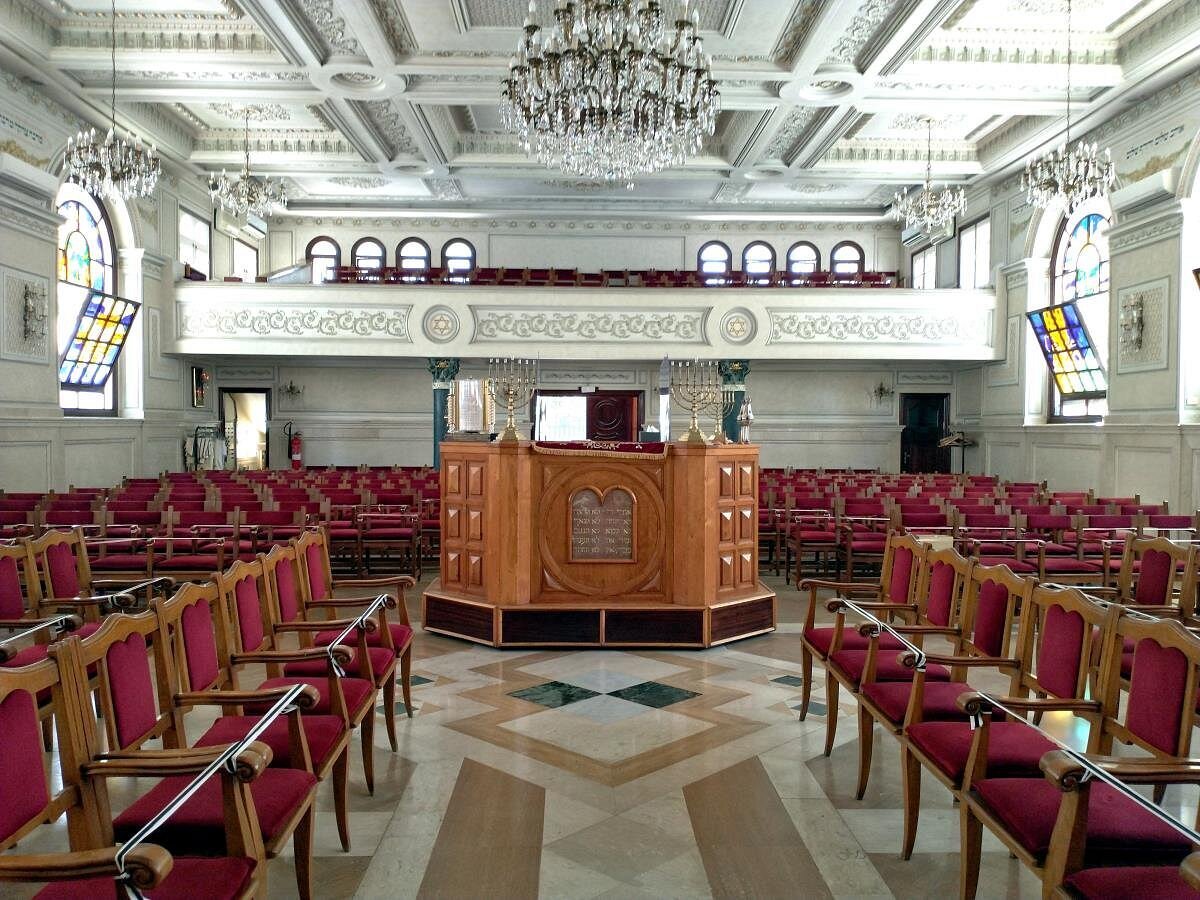
Largest Living CommunityMorocco's commercial capital is home to the country's largest contemporary Jewish community (~2,000 people), around 20 active synagogues, several kosher restaurants and butchers, four Jewish schools, and the only dedicated Jewish museum in the entire Arab world. Almost every heritage tour begins here.
- Museum of Moroccan Judaism — only Jewish museum in the Arab world (founded 1997)
- Temple Beth-El — central synagogue, famous stained-glass windows
- Ettedgui Synagogue — restored, in the old medina
- Em Habanim, Nev Shalom & ~17 other active synagogues
- Kosher restaurants & butchers, Jewish community council
Fes
Where the Mellah BeganFes is the spiritual heart of Moroccan Jewish history. The country's first mellah was formally established here in 1438 next to the royal palace, and the city was home to legendary rabbis, scholars, and craftsmen for over a millennium. Some of Morocco's most beautifully restored synagogues stand within walking distance of each other.
- Ibn Danan Synagogue — 17th c., painted wooden ceiling, blue-green tiling, subterranean mikveh
- Slat al Fassiyine Synagogue — one of the oldest, recently restored from ruin
- The Mellah of Fes — the original walled Jewish quarter, established 1438
- Jewish Cemetery — vast, with tombs of famous rabbis and female saints, active pilgrimage site
- Abensour Synagogue — visits arranged via community caretakers
Marrakech
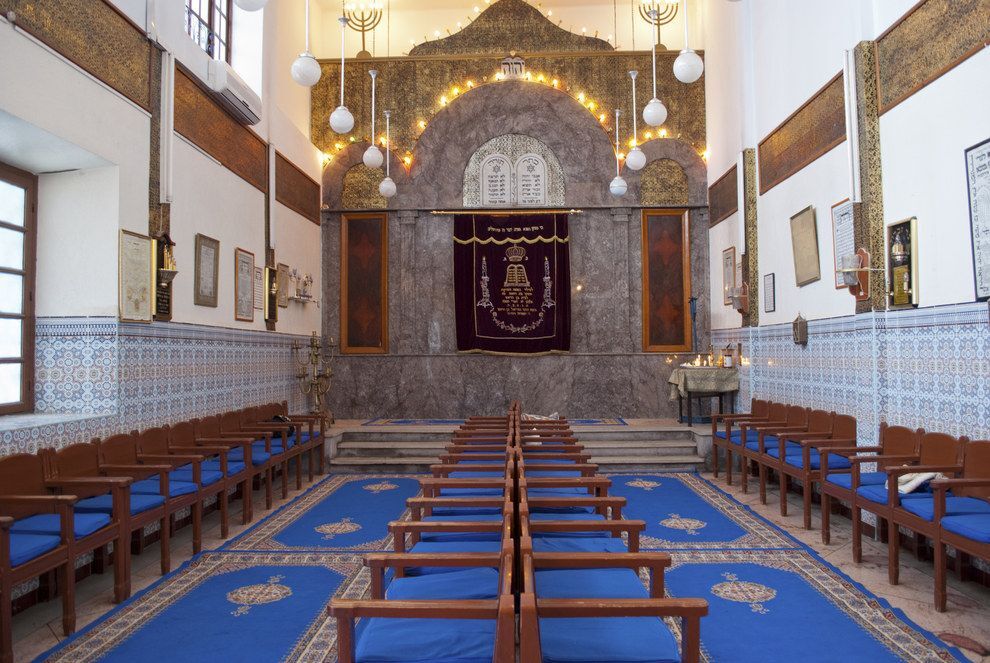
30,000 Jews at its PeakMarrakech's mellah once housed as many as 30,000 Jews and over 30 synagogues — illustrating the city's centrality to Jewish life in the south. Only a small community remains, but the surviving synagogues, cemetery, and heritage museum together tell the story powerfully.
- Lazama Synagogue (Slat al-Azama) — still in use, blue-and-white courtyard, historical plaques
- Marrakech Jewish Cemetery — vast, whitewashed tombs, centuries of presence
- The Mellah — near the Bahia Palace, now mixed but with surviving Jewish architecture
- Jewish Heritage Museum — artefacts, photographs, oral histories
- Riad El Berkani & other historic Jewish family homes
Essaouira (Mogador)
Once a Majority-Jewish PortFounded as an 18th-century Atlantic port under Sultan Sidi Mohammed ben Abdallah, Essaouira (then Mogador) became Morocco's most Jewish city — at one point with a Jewish majority population. Jewish merchants served as brokers between European traders and the Moroccan court. The Bayt Dakira complex, opened in 2020, anchors the heritage experience here.
- Bayt Dakira (House of Memory) — 2020 heritage complex, synagogue, museum, research centre
- Slat Lkahal Synagogue — historic, restored
- Haim Pinto Synagogue — pilgrimage site (Rabbi Haim Pinto hillula)
- Jewish cemeteries — on the island and near the city walls
- Mellah streets with distinctive Jewish-merchant architecture
Tetouan
Sephardic StrongholdTetouan received many of the Sephardic Jews fleeing the Iberian Peninsula after 1492 and remained a major centre of Andalusian-influenced Jewish life. It still has a small resident Jewish community, three active synagogues, and one of the largest and oldest Jewish cemeteries in Morocco.
- Three active synagogues in the mellah
- 500-year-old Jewish cemetery — one of the oldest in Morocco
- Mellah with surviving Sephardic architecture
- Haketia (Judeo-Spanish) cultural traces
Tangier
Cosmopolitan GatewayTangier's Jewish community was deeply involved in diplomacy, international trade, and the consular world, particularly during the era of the International Zone (1923–1956). Less visibly Jewish today than Tetouan, Tangier still has functioning synagogues and a cemetery, and figures prominently in the memories of Moroccan Jews now living abroad.
- Active synagogues including Shaar Raphaël
- Historic Jewish cemetery
- Sites tied to diplomatic and trading history
- The old American Legation (where Jewish merchants brokered relations)
Meknes
Imperial Hillulot CentreMeknes historically hosted a sizable Jewish community and remains an important pilgrimage destination due to the graves of revered rabbis in its old cemetery. The city still has a small Jewish community (~100 people), and is often combined with Fes and Volubilis on heritage itineraries.
- The Mellah of Meknes
- Active synagogues
- Jewish cemetery with rabbinic tombs — pilgrimage destination
- Connection to imperial-era court life under Moulay Ismail
Rabat & Salé
The Capital's CommunityMorocco's capital and its sister-city Salé historically hosted smaller but significant Jewish communities tied to administrative, mercantile, and diplomatic roles. Modest contemporary community, but functioning synagogues, a cemetery, and a historic mellah make it a worthwhile half-day stop between Casablanca and Fes.
- The Mellah of Rabat
- Functioning synagogues and cemetery
- Streets associated with historic Jewish merchant families
- Traces of trade families across the Bouregreg in Salé
Beyond the major cities, Jewish life flourished historically in Atlas Mountain Berber villages and southern oasis towns — Tiznit, Akka, and the Draa Valley among others. Most rural communities no longer exist, but their traces survive in ruined synagogues, cemeteries, and the oral memory of nearby villages. We can include these on extended heritage itineraries.
Moroccan Jewish Religious Life & Culture
Centuries of life in Morocco produced a distinctive Moroccan-Jewish identity — religious, linguistic, musical, and culinary — that endures both in Morocco today and across the diaspora in Israel, France, Canada, and the United States.
Synagogues & religious institutions
Historically, Moroccan cities could have dozens of synagogues — from large, ornate main synagogues to small, intimate prayer rooms within homes or courtyards. Synagogues typically face Jerusalem and feature wooden or stucco decoration, women's galleries, and a central bimah, with many built around the internal courtyards characteristic of Moroccan architecture. Many decommissioned synagogues have been restored as museums or cultural centres, serving both local communities and diaspora visitors interested in religious and family history.
Hillulot & pilgrimage to saints' tombs
Moroccan Jews share the standard Jewish calendar but also developed distinctive local practices, particularly hillulot — pilgrimages to the tombs of revered rabbis and saints (tzadikim) scattered across the country. Thousands of pilgrims, often from Israel, France, and Canada, return annually for these hillulot, which combine synagogue services, festive meals, and visits to cemeteries in places like Ouazzane (Rabbi Amram Ben Diwan), Essaouira (Rabbi Haim Pinto), and Ben Ahmed.
Music & language
Andalusian-influenced piyyutim (liturgical poems) and melodies fill the synagogue during Shabbat and holidays, and many have been carried into the broader Sephardic soundscape in Israel and the diaspora. Historically, Moroccan Jews spoke a mixture of languages: Judeo-Arabic across most of the country, Haketia (a Judeo-Spanish dialect) in the northern Sephardic communities, Tamazight in Amazigh regions, and Hebrew in liturgy and study. French became widespread during the Protectorate through the Alliance Israélite Universelle.
Food & the Shabbat table
Culinary culture reveals deep interweaving with Muslim neighbours — shared dishes such as couscous and tagines, alongside uniquely Jewish preparations like dafina (the slow-cooked Shabbat stew), pastilla aux poisson for Rosh Hashanah, and specific pastries and pickles associated with holidays. Traditional crafts including silver jewellery, metalwork, and textiles were often specialties of Jewish artisans, and their forms remain part of Morocco's cultural heritage even after most artisans emigrated.
Contemporary Jewish Life in Morocco
Although small in number, Morocco's contemporary Jewish community is institutionally robust relative to its size. Casablanca alone has around 20 active synagogues, several kosher restaurants and butchers, four Jewish schools, and active community organisations. Smaller communities in Rabat, Marrakech, Fes, Meknes, Tangier, and Tetouan maintain synagogues, cemeteries, and community leadership — many families have relatives abroad, functioning as part of a transnational network.
Rabbis and lay leaders coordinate with the monarchy and Jewish heritage foundations on preservation, education, and international events — including annual royal palace invitations to Moroccan rabbis and community representatives. Contemporary accounts emphasise relatively cordial relations between Jews and Muslims in Morocco, framed by official discourse that presents Jewish heritage as inseparable from national identity. Morocco's 2020 diplomatic normalisation with Israel has further encouraged cultural and tourism exchanges.
For diaspora visitors of Moroccan-Jewish descent — about one million Israelis alone are of Moroccan origin, plus substantial communities in France, Montreal, Los Angeles, and Paris — Morocco today is an open destination for roots travel, Bar/Bat Mitzvah journeys, family research, and hillula pilgrimages.
Jewish Heritage Tour Itineraries: 5, 10 & 14 Days
Every itinerary below is a fully private Jewish heritage tour built around your dates, group, and any specific family research or community connections you want to incorporate. Pricing in USD; CAD also available.
5-Day "First Taste"
A focused first heritage trip — ideal for travelers adding Morocco to a Europe or Israel itinerary. Strong on synagogue access and community connection rather than distance covered.
- Museum of Moroccan Judaism (Casablanca)
- Beth-El + Ettedgui Synagogues
- Rabat Mellah & community synagogue
- Ibn Danan + Al Fassiyine in Fes
- Optional hosted Shabbat in Casablanca
10-Day Classic Heritage
Our most-booked Jewish heritage tour. Combines all the essential urban heritage sites with the Sahara experience — the right balance for first-time visitors who want depth and the wider Morocco trip in one journey.
- Casablanca: Museum + Beth-El + Em Habanim
- Fes: Mellah, Ibn Danan, Al Fassiyine, cemetery with rabbinic tombs
- Sahara desert camp at Erg Chebbi
- Marrakech: Lazama Synagogue, Mellah, Jewish Heritage Museum, cemetery
- Hosted Shabbat option + kosher meals on request
14-Day "Full Legacy"
The complete arc of Moroccan Jewish heritage — for travelers who want everything, including the northern Sephardic ports, Atlas mountain hillula sites, and Essaouira's Bayt Dakira.
- Tangier + Tetouan (3 active synagogues + 500-year cemetery)
- Chefchaouen + Volubilis side trip
- All 4 imperial cities & their mellahs
- Sahara + optional Atlas hillula sites
- Essaouira: Bayt Dakira, Haim Pinto, port history
The Signature Tour: 10-Day Jewish Heritage Morocco
Our most-booked Jewish heritage itinerary. Designed in consultation with rabbinical contacts in Casablanca, Fes, and Marrakech, and refined over hundreds of trips with North American and European Jewish families since 1999. Private vehicle, English-speaking driver-guide, licensed local guides at every site, hosted Shabbat option, kosher meal arrangements, and family-history research support.
See the Full 10-Day Itinerary →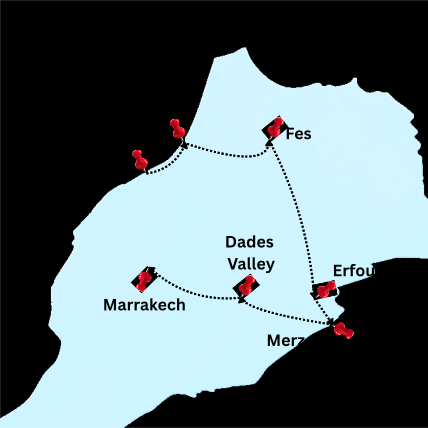
Heritage Add-Ons: Shabbat, Kosher Meals & More
Any of these can be woven into a heritage itinerary of any length. Most require advance arrangement — we handle the coordination with local synagogues, community leaders, and caretakers on your behalf.
Hosted Shabbat
Friday-night services and a hosted dinner with a local Jewish family or community in Casablanca, Marrakech, or Fes. Arranged through synagogues and community organisations.
Private synagogue visits
Access to synagogues not on the public schedule — opened by the caretaker or elder, who shares oral history and family memories. Especially powerful in Fes, Meknes, Marrakech, Tetouan, and Essaouira.
Kosher meals & catering
Casablanca kosher restaurants, kosher-prepared meals for travel days, and Shabbat-friendly logistics across the itinerary. Strict kashrut accommodated on request.
Jewish-Moroccan cooking
Home-hosted Shabbat-recipe workshops — dafina, pastilla, holiday breads, and Sephardic pastries. Often in private homes in Marrakech or Casablanca.
Piyyutim & Andalusian music
Concerts and intimate listening sessions of Moroccan-Jewish liturgical music, often held in restored synagogues or at Bayt Dakira in Essaouira.
Hillula pilgrimages
Visits to the tombs of Rabbi Amram Ben Diwan (Ouazzane), Rabbi Haim Pinto (Essaouira), and other tzadikim. We can time itineraries around specific hillula dates.
Family-history research
If you have family from a specific Moroccan-Jewish community (Fes, Tetouan, Mogador, etc.), we coordinate with community archivists and cemetery caretakers to locate ancestral graves and family addresses.
Bar & Bat Mitzvah trips
Heritage Bar/Bat Mitzvah journeys with on-site ceremonies at restored historic synagogues, photography, and multi-generational logistics for extended families.
Morocco Jewish Heritage FAQ
Answers to the questions every heritage traveler asks before booking. If yours isn't here, we reply to direct inquiries within 24 hours.
How long has there been a Jewish community in Morocco?
Jews have lived in the territory of modern Morocco since at least Roman times, with evidence from ancient tombstones in Volubilis and inscriptions across the region. Scholars trace some Amazigh (Berber) tribes of Jewish faith near Fes back to the 2nd century BCE. The community grew significantly after the destruction of the Second Temple in 70 CE and was massively reinforced by Sephardic Jews expelled from Spain and Portugal in 1492.
How many Jews live in Morocco today?
About 2,500 to 3,000 Jews live in Morocco today, primarily in Casablanca with smaller communities in Rabat, Fes, Marrakech, Meknes, Tangier, and Tetouan. At its peak in 1948, Morocco was home to 250,000 to 300,000 Jews — the largest Jewish community in any Muslim-majority country. Today the diaspora is global: roughly one million Israelis are of Moroccan-Jewish descent, with major communities also in France, Canada (especially Montreal), and the United States.
What is a mellah in Morocco?
A mellah is the traditional Jewish quarter found in Moroccan cities, historically located adjacent to the royal palace and surrounded by walls. The word comes from the Arabic for salt and is thought to derive from a salt marsh near the original Jewish quarter in Fes (established in the 15th century). Mellahs typically contained synagogues, schools, ritual baths, communal ovens, and tightly packed housing — forming a semi-autonomous Jewish quarter within the broader medina.
Did King Mohammed V protect Moroccan Jews during the Holocaust?
Moroccan Jewish memory places strong emphasis on royal protection during the Vichy period of World War II. Multiple accounts recount that Sultan (later King) Mohammed V resisted anti-Jewish decrees from the collaborationist Vichy regime, famously insisting that Moroccan Jews were his subjects and would not be singled out. While Moroccan Jews were affected by some discriminatory laws and economic hardship, they were not deported en masse to Nazi camps. The narrative of royal protection remains a central part of how Moroccan Jews and the monarchy frame their historical relationship.
What is the Museum of Moroccan Judaism in Casablanca?
The Museum of Moroccan Judaism in Casablanca is the only dedicated Jewish museum in the Arab world. Founded in 1997 by the Foundation of Moroccan Jewish Heritage, it occupies a former Jewish orphanage and showcases artefacts, photographs, religious objects, traditional costumes, and documents covering 2,000 years of Jewish presence in Morocco. It is the starting point of nearly every serious Jewish heritage tour of Morocco.
Which Moroccan cities have the most important Jewish heritage sites?
The eight cities essential to any Jewish heritage tour are: Casablanca (Museum of Moroccan Judaism, Beth-El, Ettedgui), Rabat (mellah, synagogues), Fes (Ibn Danan & Al Fassiyine synagogues, the original mellah, vast Jewish cemetery), Meknes (synagogues, pilgrimage cemetery), Marrakech (Lazama Synagogue, Mellah Heritage Museum, vast cemetery), Essaouira (Bayt Dakira complex, Haim Pinto Synagogue, Slat Lkahal), Tangier (synagogues and cemetery), and Tetouan (three active synagogues, 500-year-old cemetery).
Can I attend Shabbat services at a Moroccan synagogue as a visitor?
Yes. Casablanca, Marrakech, Fes, and several other cities have active synagogues that welcome visitors for Shabbat services. Gateway2Morocco can coordinate hosted Shabbat services and meals with local Jewish communities in Casablanca, Marrakech, or Fes through synagogues and community organisations. Advance arrangement is essential — most synagogues require contact through the community council, which we handle on your behalf.
Are kosher meals available on a Morocco tour?
Yes. Casablanca has multiple kosher restaurants and butchers and is the easiest city to keep kosher in. We arrange kosher-supervised meals through community-approved suppliers in Casablanca, Marrakech, and Fes. For travelers requiring strict kashrut throughout the trip, we coordinate kosher-prepared meals for travel days and pre-arranged hosted Shabbat dinners with local families on request.
What are hillulot in Morocco?
Hillulot are annual pilgrimages to the tombs of revered Jewish saints (tzadikim) scattered across Morocco. Thousands of pilgrims — primarily from Israel, France, and Canada — return to Morocco each year for these gatherings, which combine synagogue services, festive meals, and visits to cemeteries. Major hillulot include those at Ouazzane (Rabbi Amram Ben Diwan), Essaouira (Rabbi Haim Pinto), and Ben Ahmed. Gateway2Morocco can build itineraries around specific hillula dates.
Is Morocco safe for Jewish travelers and groups?
Yes. Morocco is one of the most welcoming Arab-majority countries for Jewish heritage travel. The Moroccan constitution (2011) explicitly recognises the Hebraic component as one of the sources of national identity. King Mohammed VI has personally backed the Foundation of Moroccan Jewish Heritage in restoring synagogues, cemeteries, and creating museums. Morocco normalised diplomatic ties with Israel in 2020. With a private tour, a vetted local driver-guide accompanies you throughout — exactly as we'd recommend in any major European or North American city.
What languages did Moroccan Jews speak?
Moroccan Jews historically spoke a mix of languages depending on region: Judeo-Arabic dialects across most of the country, Haketia (a Judeo-Spanish dialect) in the northern Sephardic communities of Tangier and Tetouan, Tamazight (Berber) in Atlas Mountain and southern oasis communities, and Hebrew for liturgy and study. French became widespread among Jewish families during the French Protectorate (1912–1956) through schools run by the Alliance Israélite Universelle.
What's the difference between Toshavim and Megorashim Moroccan Jews?
Toshavim (residents) are the older, locally-rooted Moroccan Jewish communities present since Roman or even pre-Roman times — many of Amazigh (Berber) origin. Megorashim (expellees) are descendants of Sephardic Jews who arrived after the 1492 expulsion from Spain and Portugal, settling primarily in northern and Atlantic cities like Tetouan, Tangier, Fes, and Rabat. Over centuries the two traditions blended, producing the distinctive Moroccan-Sephardic identity still visible today in synagogue rites, melodies, and family customs.
How long does a Jewish heritage tour of Morocco take?
5 days is the minimum that gives a meaningful Jewish heritage experience — Casablanca, Rabat, and Fes. 10 days is our signature itinerary covering Casablanca, Rabat, Fes Mellah, Marrakech (Lazama Synagogue and the Mellah), and a Sahara desert camp. 14 days is the full legacy tour covering the northern Sephardic ports (Tangier, Tetouan), all imperial cities, hillulot sites, the Sahara, and Essaouira's Bayt Dakira.
What is Bayt Dakira in Essaouira?
Bayt Dakira (House of Memory) is a heritage complex in Essaouira's old mellah, inaugurated in 2020 under the patronage of King Mohammed VI. It combines a restored synagogue, exhibition spaces, and a research centre dedicated to Jewish-Muslim coexistence in Essaouira and Morocco more broadly. It's a key stop on any heritage tour visiting Essaouira (Mogador), which was historically one of Morocco's most Jewish cities — once with a majority Jewish population.
Why book a Jewish heritage tour with Gateway2Morocco?
Three reasons. First, we are a Canadian-licensed travel agency (BPCPA #80460) — your booking carries the consumer protections of a Canadian agency, not just informal arrangements with a Moroccan operator. Second, our founder Brahim Jounh is Moroccan-born with 25+ years of in-country expertise, and most of our heritage clients have Moroccan-Jewish family roots — we know which synagogues require advance arrangement, which caretakers hold the keys, and how to coordinate Shabbat hosting and kosher meals. Third, every tour is 100% private, customised to your dates, group, and any specific family heritage research you want to incorporate.
Ready to plan your Jewish heritage tour of Morocco?
Tell us your dates, group, and what you'd most like to see or research — family roots, specific synagogues, a hillula pilgrimage, a Bar/Bat Mitzvah journey, hosted Shabbat. You'll receive a complete custom itinerary in USD or CAD within 48 hours — with no deposit required until the trip is exactly right.
★★★★★ 4.9 on TripAdvisor · 298 reviews · BPCPA Lic. #80460 · IATA & ACTA accredited · Founded 1999