Start hereLuxury desert camps in Morocco: two dune seas, two different trips
Almost every luxury desert camp in Morocco sits in one of two places. Erg Chebbi, the dune sea beside the village of Merzouga in the southeast, is the famous one: tall, golden, photographed endlessly, and reachable on a paved road. Erg Chigaga, beyond the end of the road at M’Hamid in the Draa Valley, is the remote one: lower, longer, quieter, and reached only by 4x4 across open desert.
Clients often ask us to settle Merzouga vs Erg Chigaga: which is “better”? That is the wrong question. They are different trips that happen to share the word Sahara, and the right answer depends on your route, your age, the month and how much you care about silence versus spectacle. Here is how the two compare, what the camps are actually like, and how we match people to them.
Erg Chebbi at Merzouga: the tall dunes
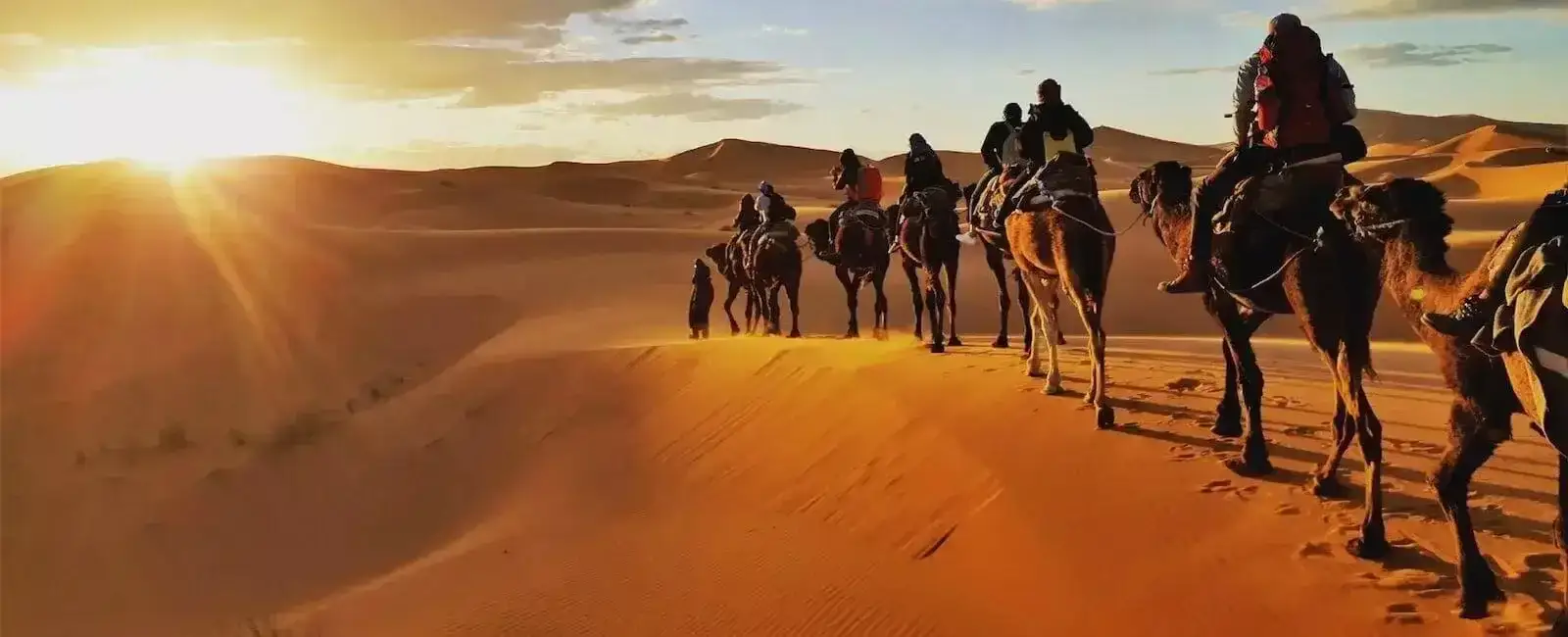
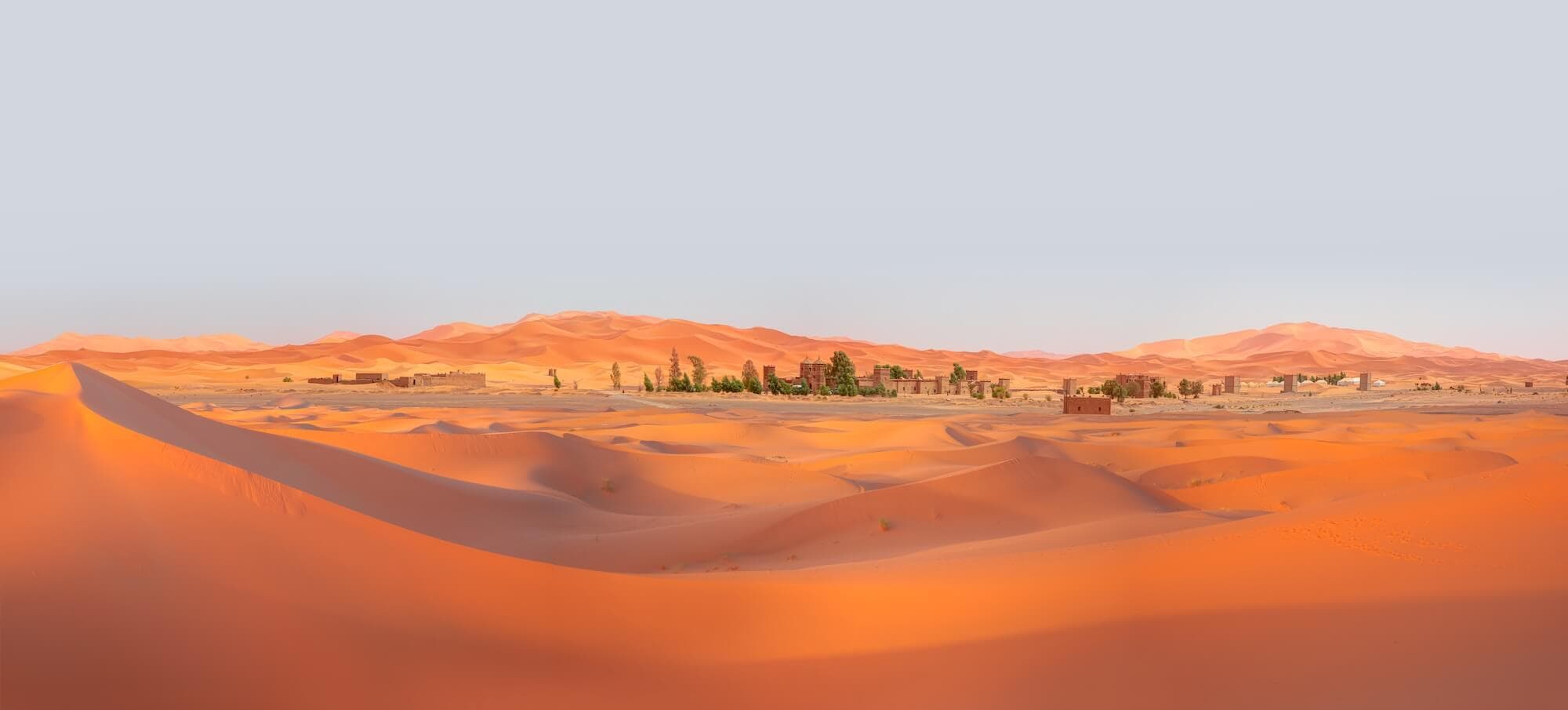
Erg Chebbi runs about 28 km from north to south and 5 to 7 km across, and its highest dunes rise around 150 metres above the surrounding stony plain. They are the tallest dunes most visitors to Morocco will ever see, and in the late afternoon they glow orange against a clean horizon. Merzouga lies about 35 km beyond Rissani on a paved road, and the camps sit a short 4x4 drive or camel ride into the sand from the edge of the village.
The trade-off is company. Erg Chebbi has the most camps and the most visitors of any Moroccan desert, and on a busy October evening you will see other camps’ lights from your dune. Authorities closed unlicensed camps in 2019 over waste and water concerns, and the better luxury Sahara camps are well spaced. But you are not alone out there, and anyone who tells you otherwise is selling something.
Merzouga fits naturally into a loop of Morocco. Coming from Fes, we drive over the Middle Atlas through Ifrane and down the Ziz Valley, usually with a night in Erfoud, then continue west through the Todra and Dades gorges toward Ait Ben Haddou and Marrakech. It is the desert on our two-week Morocco itinerary and most of our classic routes.
Erg Chigaga beyond M’Hamid: the empty one
Erg Chigaga lies about 56 km southwest of M’Hamid El Ghizlane, and there is no paved road to it. The usual approach is roughly two hours of 4x4 driving on desert track, with no marked route. The track shifts with wind and rain, so this is never a self-drive. The alternative exit runs west across the dry lakebed of Iriki, inside Iriqui National Park, toward Foum Zguid. The erg itself stretches roughly 40 km in length.
Its dunes are lower. Geographic references put the highest at a little over 50 metres above the surrounding land. Some local marketing claims they are Morocco’s tallest; in our experience of both, that is not what you see. What Chigaga has instead is space. There are far fewer camps, spread further apart, no village at the edge of the sand, and a much stronger sense of being properly out in the desert. The night sky is darker, the silence more complete.
Chigaga works best on a trip based around Marrakech. The drive south over the Tizi n’Tichka pass and down the Draa Valley to M’Hamid is long enough that we always break it with a night along the way, as our nine-day Draa Valley and Erg Chigaga journey does.
Side by sideThe comparison in one list
- Dunes: Erg Chebbi’s highest reach about 150 m; Erg Chigaga’s a little over 50 m
- Access: Merzouga by paved road, then minutes into the sand; Chigaga by about two hours of 4x4 track from M’Hamid
- Crowds: Erg Chebbi has many camps and visitors; Chigaga has few, widely spaced
- Camp choice: much wider at Merzouga, from simple to very polished; narrower at Chigaga
- Best route fit: Merzouga suits a Fes-to-Marrakech loop; Chigaga suits a Marrakech-based trip
- Non-camp option: Merzouga has proper hotels and kasbahs at the edge of the dunes; Chigaga has none
Manage expectationsWhat “luxury camp” really means
The phrase covers a wide range, so here is what the good end generally looks like. A private tent, usually on a raised floor with rugs, big enough to stand and move around in. A real bed with good linen and heavy blankets. An en-suite bathroom inside or attached to the tent, with a flush toilet and a hot shower. Electric light and somewhere to charge a phone, often solar-powered. Dinner at proper tables in a dining tent, a fire afterwards, and usually drumming. In winter, extra blankets and sometimes heaters.
What it cannot be is a hotel. Tent walls are canvas, so you hear the wind and your neighbours. Sand gets into everything, however well the camp is swept. Power can be limited late at night, Wi-Fi is patchy or absent, and water pressure is what a desert allows. There is no air conditioning worth the name in July, and the cold on a January night is real even under good blankets. None of this spoils the night for most people. It simply helps to arrive expecting a very comfortable camp, not a five-star room that happens to be in the sand.
What to ask about any desert camp
- ✓Is the bathroom private and inside or attached to our tent, or shared?
- ✓Is there hot water all evening, or only at certain hours?
- ✓How is the tent heated in winter, and is there any cooling in summer?
- ✓How far is the nearest neighbouring camp?
- ✓Can we reach the camp by 4x4 if we would rather not ride a camel?
- ✓Is there electricity through the night?
- ✓What happens to our main luggage? At most camps you take an overnight bag and the rest stays with your driver
SeasonsWhen to go: heat, cold and wind
October, November, March and April are the sweet spot for both deserts: warm days and nights cool enough to want a blanket. December to February brings pleasant days and genuinely cold nights, often close to freezing, so dress in layers and choose a camp with good bedding or a hotel with walls. June to August is extreme, with afternoons commonly well above 40°C. We plan desert nights in summer around dawn and dusk only, and we steer clients away from remote Chigaga in high summer altogether.
Spring is the windiest season, and late March to May is when sandstorms are most likely. Most days are still fine, but a blowing afternoon can cancel the sunset. If your dates are fixed in April, it is one more reason to keep a little slack in the schedule. Our Sahara desert tours page covers the desert routes in more depth.
Our libraryWhich of our camps fits which style
We only book places we know, and these are the ones in our library for each desert. We describe amenities by style below. The specifics of each tent and bathroom, and the room we have actually reserved, are confirmed in your proposal.
Merzouga and Erg Chebbi
Madu Premium Camp is our default at Erg Chebbi and the camp on our Exotic Morocco and Discover Morocco itineraries. It sits out on the dunes near Hassilabied, with tented suites, and it can be booked across our Classic to Luxury styles.
Sahara Stars Camp is a second Merzouga option. By its own description it has 16 tents, each with a private bathroom and shower.
Riad Madu, Boutique Hotel Riad Xaluca and Kasbah Hôtel Tombouctou are our non-camp choices at the edge of the dunes. You sleep behind proper walls in a proper room, and still ride or drive into Erg Chebbi for sunset and sunrise. For light sleepers, older travellers, and anyone going in January, this is often the smarter choice, and nobody should feel it is a lesser one.
Erg Chigaga
Touareg Dream Chigaga Luxury Camp is our comfortable base at Erg Chigaga, and it is where guests on our Draa Valley and Erg Chigaga journey spend their night in the big dunes.
Erg Chigaga Mobile Camp is a different thing entirely: a simpler camp set up for walkers on a desert trek, with mattresses and blankets rather than en-suite tents. It is for people who want the walking and the camels, and we do not dress it up as luxury.
Matching people to placesWho should choose which
- First trip to Morocco: Merzouga. It fits the classic Fes-to-Marrakech route, and the dunes are the ones you have pictured
- Seniors and anyone with limited mobility: Merzouga, with 4x4 access to the tent or a night in Kasbah Tombouctou or Riad Xaluca. The long piste to Chigaga is bumpy for two hours each way. See our Morocco tours for seniors
- Families with children: Merzouga, for shorter transfers, the choice of camps and sandboarding on the big dunes. Our family tours page has more
- Photographers: it depends. Erg Chebbi gives you height, sharp ridges and dramatic light; Chigaga gives you untracked sand and darker skies. Serious photographers should consider two nights
- Honeymooners: either. Chigaga for privacy and silence; Merzouga for a more polished camp and an easier journey
- Return visitors and walkers: Chigaga. It feels like a different country from Merzouga
If you are weighing up comfort more broadly, our piece on riad versus hotel accommodation covers the same trade-offs in the cities. When you are ready, tell us your dates and we will suggest the right desert for them. For the evening itself, from the camel ride to the sunrise, read what to expect on your first Sahara desert night.
For a first trip, choose Merzouga, one night in a good camp, and do not apologise if you would rather sleep in a kasbah at the edge of the dunes. Save Erg Chigaga for when silence matters more to you than dune height, give it a proper itinerary through the Draa Valley, and never try to squeeze it into a two-day dash from Marrakech.
Where to startJourneys with a desert night
Two of these reach Erg Chebbi as part of a loop from Casablanca, and one goes deep to Erg Chigaga from Marrakech. Any of them can be built in our Luxury style (4–5 star, from about US$490 per person per day for two sharing) or Ultra-Luxury (palaces and villas, from US$750). See all our luxury Morocco tours.
What people ask usFAQs
Tell us your dates and how you like to sleep, and we will tell you honestly which desert, and which camp or kasbah, fits. You will have a complete private itinerary within 48 hours.
Plan my trip