Cemetery · Chefchaouen
Jewish Cemetery of Chefchaouen
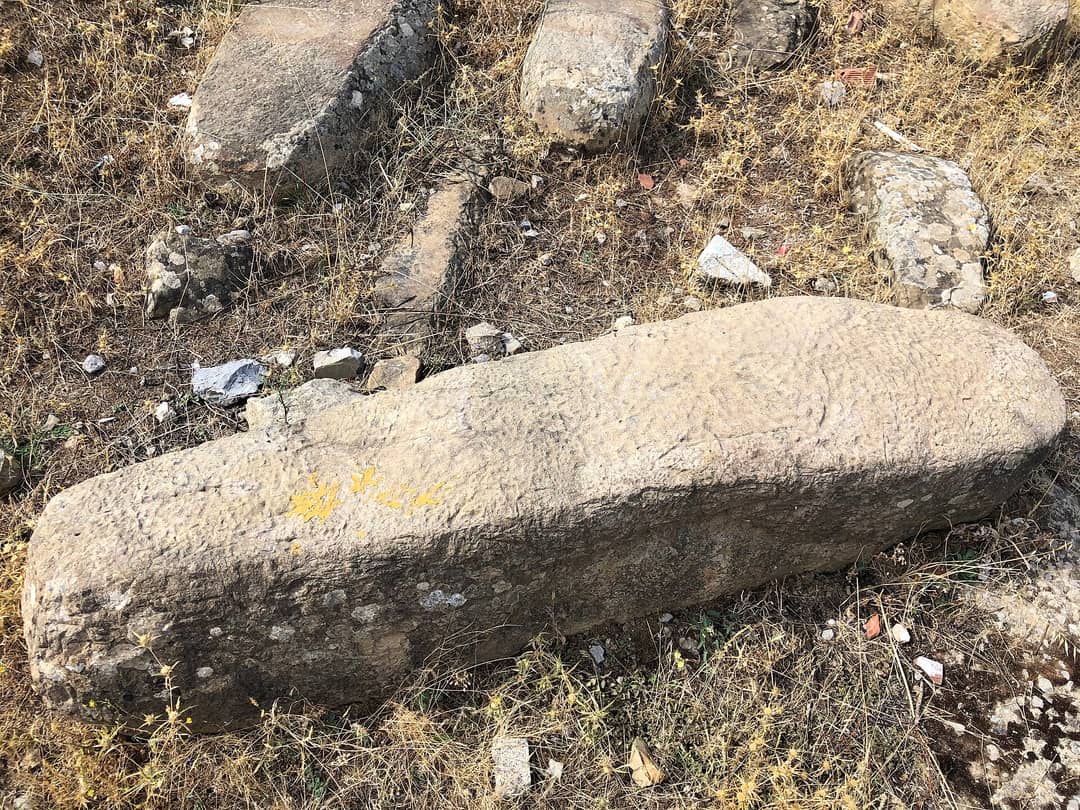
On the road out of Chefchaouen towards Ouezzane is the town’s small Jewish cemetery, a reminder of the Sephardic community that left between the 1940s and the 1960s. Its oldest graves are rough limestone blocks and anthropomorphic stones, and a few once bore carved faces of the dead. Today it is fenced and laid out as a small park, and its carvings are fading.
The Jews of Chefchaouen
Chefchaouen’s Jewish community was largely made up of megorashim, Jews expelled from Spain, and kept Judeo-Spanish as its language. Its mellah is said to have been built in the same period as Tetouan’s, first outside the walls near the river and later inside the town near the gate called Bab el Mellah. Charles de Foucauld, who visited in disguise around 1883, described Jews as about a third of the population.
In 1924 just over 200 of the town’s roughly 2,000 houses belonged to Jews, who worked as merchants, tanners, cloth traders and silversmiths. Families from Rif villages arrived between 1927 and the early 1930s. Two local writers link the town’s blue-painted houses to these arrivals; it is a widely repeated account rather than a documented fact. The town had at least three synagogues before the Spanish Civil War. Emigration began in the 1940s, to Tetouan, Ceuta, Melilla, Venezuela and Israel, and the last families left in the 1950s, or by another account in 1968.
What you’ll see
The cemetery holds two kinds of tomb. The oldest are large, barely worked blocks of limestone, thought to date from the generations after the expulsion from Spain. Later tombs are anthropomorphic, shaped with a rounded head and no inscription, and some of the more prominent ones are decorated with concentric circles. They resemble the old Castilla section of the Jewish cemetery of Tetouan.
A local custom, unusual in Morocco, was to carve the face of the dead person into the stone. Most of these faces have worn away and only a few survive. There is also a group of about a hundred newer tombs in neat rows, which a 2012 account described as completely neglected.
Since then the cemetery has been fenced with railings and turned into a small park, which local people use as a path through to another part of town. A visitor in March 2026 reported that the carved symbols are becoming harder to make out.
Visiting respectfully
The cemetery sits at the edge of town and is easy to combine with the Chefchaouen mellah. Because it doubles as a park, the exact access arrangement is unclear, and we confirm it locally before a visit. However public it looks, it is still a burial ground: walk on the paths, do not climb on tombs or touch the fragile carvings, and dress modestly. No list of named graves has been published, so we cannot promise to locate a particular family grave here.
Jewish Cemetery of Chefchaouen: questions travellers ask
Are there faces carved on the tombs?
Some tombs once bore the carved face of the dead person, a local custom. Most have worn away, and only a few remain.
Can you find my family’s grave in Chefchaouen?
No list of named graves has been published, and many older stones carry no inscription, so we cannot promise to locate one.
Is the cemetery open to visitors?
It is fenced and laid out as a park that people walk through. We confirm the current access arrangement locally before your visit.
Sources. Ceuta desconocida (updated 2026); Sergio Barce blog (José Edery Benchluch, 2012). Researched and fact-checked by Gateway2Morocco, October 2026. Access to religious sites changes; we confirm every visit when we plan your trip.