Synagogue · Tangier medina
Moshe Nahon Synagogue, Tangier
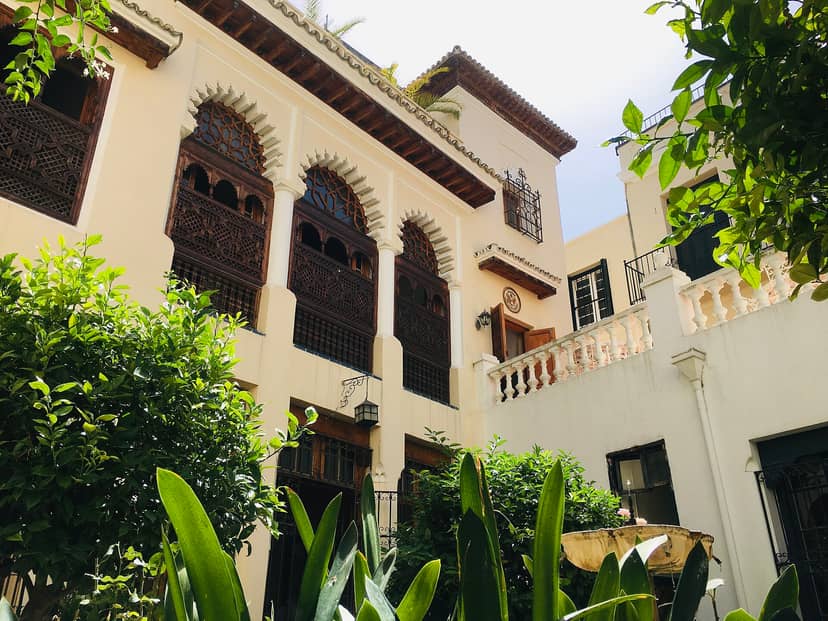
The Moshe Nahon Synagogue is a 19th-century prayer house in a dead-end alley off Rue des Synagogues, in Tangier’s medina. Closed for decades and restored in 1994, it now operates as a museum, and some consider it one of the most beautifully restored Jewish sites in Morocco. Inside are carved stucco walls, Andalusian-style silver lamps, a wooden Torah ark and an upstairs women’s gallery hung with embroidery and ketubot.
The story
The synagogue was built by Moïse (Moshe) Nahon, an educator and scholar from an influential Tangier Jewish family. Most sources date it to the 19th century; one Moroccan newspaper gives 1876.
Tangier never had a walled mellah. Jewish families lived mainly in the lower medina, and synagogues clustered in the Beni Idder quarter around Rue des Synagogues. Estimates of how many prayer houses the city once had range from 16 to more than 20.
As the community emigrated in the second half of the 20th century, the Nahon synagogue stopped functioning and fell into disrepair. After its restoration in 1994 it became a museum. Besides its own fittings it displays ritual objects gathered from closed synagogues, including old chandeliers, ceremonial glassware and textiles embroidered in Hebrew.
Inside the synagogue
A corridor leads to a small courtyard, and the prayer hall opens beyond it. The decoration is Andalusian in style: carved stucco walls with ornamental embedded columns, trilobed arches and arabesques in floral and geometric patterns. Arabic calligraphy is repeated in three vertical medallions, and the lower walls are lined with carved wood panels.
The high ceiling is elaborately decorated, with a large skylight at its centre. Silver chandeliers and lamps hang throughout, many given by former congregants in memory of relatives. The wooden heikhal (the ark that holds the Torah scrolls) and the panels above it carry Hebrew calligraphy, and a carved wooden lectern stands on the south side of the hall. Look at the benches: many still bear brass plaques with the names of the families who sat there. Semicircular windows above the entrance are set with floral stained glass.
A staircase from the courtyard climbs to the hazara, the women’s gallery. Its walls are plain and now serve as exhibition space for framed embroidery, tapestries, banners, ketubot (Jewish marriage contracts) and other objects donated by Tangier’s Jewish community.
Visiting today
The synagogue is a regular stop on Jewish heritage walks through the medina. In 2021 the Tangier Jewish community included it in a heritage circuit with the Rabbi Akiba synagogue, the Jewish museum in the former Assayag synagogue and the old cemetery on Rue du Portugal. Families still rent it for celebrations such as bar and bat mitzvahs and anniversaries.
We have not found published opening hours. Access is normally arranged through a guide or the Tangier Jewish community, and we set it up when we plan your trip. It appears on our sample Jewish heritage tour.
Etiquette
This is a consecrated synagogue as well as a museum. Dress modestly, and men should cover their heads. Ask before taking photographs, and do not photograph a family celebration if one is under way.
Nearby in the medina
The Rabbi Akiba synagogue, also kept as a museum, is close by, and the Beit Yehuda museum lies near the Petit Socco. The old Jewish cemetery is just outside the medina walls, below the American Legation. Our Tangier Jewish quarter page links the sites into a walk, and the Tangier and Tetouan guide covers the wider region.
Moshe Nahon Synagogue: questions travellers ask
Is the Nahon synagogue still used for prayer?
It no longer holds regular services and operates as a museum, though families still rent it for celebrations such as bar and bat mitzvahs. Tangier’s functioning synagogue is Shaar Raphael on Boulevard Pasteur.
Can non-Jews visit?
Yes, visitors of all backgrounds come as part of medina heritage walks. Dress modestly, and men should cover their heads.
Do I need a guide?
There are no published opening hours, so access normally goes through a guide or the Tangier Jewish community. We arrange this as part of your itinerary.
Can we hold a bar or bat mitzvah there?
The synagogue has been rented for bar and bat mitzvahs and anniversaries. We can ask the Tangier community about availability and organise kosher catering through certified caterers.
When was it built?
Sources agree on the 19th century, and one Moroccan newspaper gives 1876. It was restored in 1994.
Sources. Archnet (2017); New York Jewish Travel Guide (2021); Aujourd’hui le Maroc; Médias24 (2021); Hadassah Magazine (2020); JTA (2020). Researched and fact-checked by Gateway2Morocco, October 2026. Access to religious sites changes; we confirm every visit when we plan your trip.