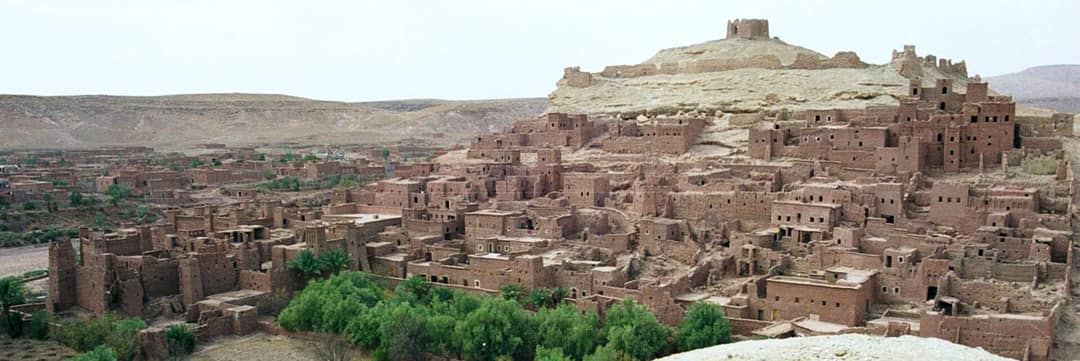
The Jewish south: villages, oases and caravan towns
Jewish life in the south is old, although its earliest chapters survive mainly as tradition. Ifrane of the Anti-Atlas is commonly held to be Morocco’s oldest Jewish community, and legends in the Draa speak of a Jewish kingdom with its capital at Tamegroute; historians have not confirmed either story. Firmer history begins with the caravan cities. The University of Haifa’s Jewish communities project dates the Draa communities to at least the 9th century, and Sijilmasa, near today’s Rissani, had an important Jewish community until the Almohad conquest of about 1146, when many of its Jews were massacred.
Over the following centuries Jews in the south were traders, craftsmen and farmers. In the Draa they financed caravans, worked West African gold into bars and coins, owned date palms and worked as jewellers, tinsmiths, saddlers and cobblers. In the Souss they were silversmiths, tailors, pedlars and agents for the merchants of Agadir and Essaouira, and many spoke Tashelhit (Berber) as well as Arabic. Draa Jews also used a coded language of their own, known as Lashoniyya. The Tafilalet became a centre of Jewish learning and the home of the Abuhatzeira rabbinic family.
Haifa’s researchers estimate more than 6,500 Jews in the Souss in the 1950s, including about 2,000 in Agadir, and about 30 small communities in the Draa, the largest with 200 to 300 people. Then, between the mid-1950s and the mid-1960s, almost every community emigrated, most to Israel and some via Casablanca. Whole villages left together: Ifrane’s community departed as a group in 1958, and all 321 Jews of Ighil n’Oghou left in 1963.
Agadir, Taroudant and the Souss
Agadir. On 29 February 1960 an earthquake destroyed the old city of Agadir. Estimates of the Jewish dead range from several hundred to about 1,200; Haifa puts it at about 1,000 of the city’s 2,300 Jews. In the Agadir Jewish Cemetery about two-thirds of the tombs belong to victims of the earthquake. The tomb of Rabbi Khalifa Ben Malka, an 18th-century merchant, poet and leading rabbi of Agadir, was moved in 1927 to a marble shrine in Talborjt; whether it survived the earthquake intact is not confirmed. His hilloula is on 3 Elul (5 September in 2027).
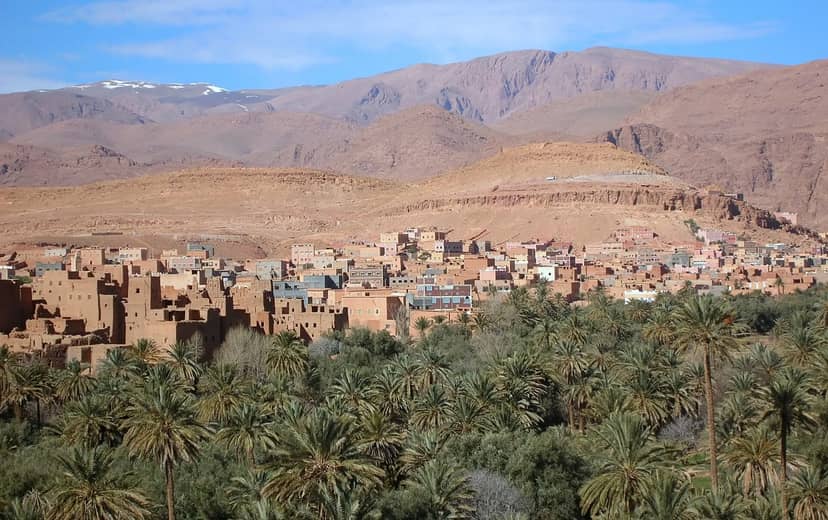
Taroudant. The walled city had the largest mellah of the Souss, with about 950 Jews in the 1950s, and was a centre of Kabbalah: Rabbi Moses ben Maimon Albaz began his work Hekal haKodesh here in 1575. The former mellah of Taroudant lies inside the walls and is seen on a walk through town; its former synagogue in the house of Sisso Zafrani is now a crafts shop. A small number of Jewish families, mainly of French origin, lived on the outskirts in 2023.
Rabbi David Ben Baroukh. East of Taroudant, near Ouled Berhil, the Shrine of Rabbi David Ben Baroukh HaCohen is a major pilgrimage site of the Souss. He was an 18th-century Kabbalist and miracle-worker (died 1760 or about 1785), and the Azugh family still maintains the complex, which has hundreds of pilgrim rooms. His hilloula, the annual pilgrimage on the anniversary of a tzaddik’s death, is held around the last day of Hanukkah (2 Tevet; 12 December in 2026) and draws hundreds to over 2,000 pilgrims. Outside the hilloula, visits are arranged through the caretakers. He is not the 20th-century Rabbi David HaCohen Azugh, “Baba Doudou”, who is buried in Marrakech.