Gateway2Morocco Travel

City guide · Rabat & Salé

Jewish Rabat and Salé: A Traveller’s Guide

Rabat and Salé face each other across the mouth of the Bou Regreg river, and each had its own Jewish quarter. Rabat’s mellah is still a busy market district with one well-kept synagogue, and the two cities’ cemeteries hold three of Morocco’s venerated rabbis, each with an annual hilloula. It is an easy, rewarding day from Casablanca, best planned with the community’s help.

  • Rabat’s 1807 mellah and its daily market
  • The Rabbi Shalom Zaoui synagogue
  • Tombs of Rabbi Eliezer Davila and Rabbi Raphael Encaoua
  • Salé’s Marinid gate and old Jewish quarter
Mellah of Rabat

Two cities, two Jewish quarters

Diarna describes Salé’s Jewish quarter as older than Rabat’s, though its founding date is not documented. It lay in the old medina beside Bab el-Mrissa, the sea gate built between 1260 and 1270 under the Marinid sultan Abu Yusuf Yaqub, which is also called Bab Mellah. From 1610 Salé took in refugees expelled from Spain, and its mellah became an important centre of rabbinic learning. Two of the rabbis most venerated in the region were born there: Eliezer Davila in 1714 and Raphael Encaoua in 1848.

Rabat’s mellah is younger. In 1806–1807 Sultan Moulay Slimane had a new quarter laid out on former fruit orchards inside the medina walls, against the Andalusian wall above the river, and moved the city’s Jews there from the medina. The same sultan created a new mellah in Tetouan in the same years. Diarna, the heritage-mapping project, describes the mellah as meant both to separate and to protect the community, so that an attack on it was a challenge to the sultan’s authority. Diarna also notes a Jewish presence in Rabat going back to before Islam; the documented story is much later.

The twin cities’ Jewish population was about 5,000 in 1881. After 1912, when the French made Rabat the capital, the city grew fast, and by 1947 Rabat had more than 15,000 Jews, many of them by then living outside the mellah. In 17th- and 18th-century Morocco, Jews from these ports served as traders and envoys: in Salé, the house of Moses Ben Attar, a diplomat for Sultan Moulay Ismail who negotiated a treaty with Britain, is now a school.

Emigration from 1949 onwards, and after independence in 1956, went mainly to France, the United States, Canada and Israel. By 1998 only three Jewish families still lived in Rabat’s mellah. A small community remains, based in the new town, where Diarna records a newer synagogue and the Centre de la Communauté Israélite.

Rabat’s mellah today

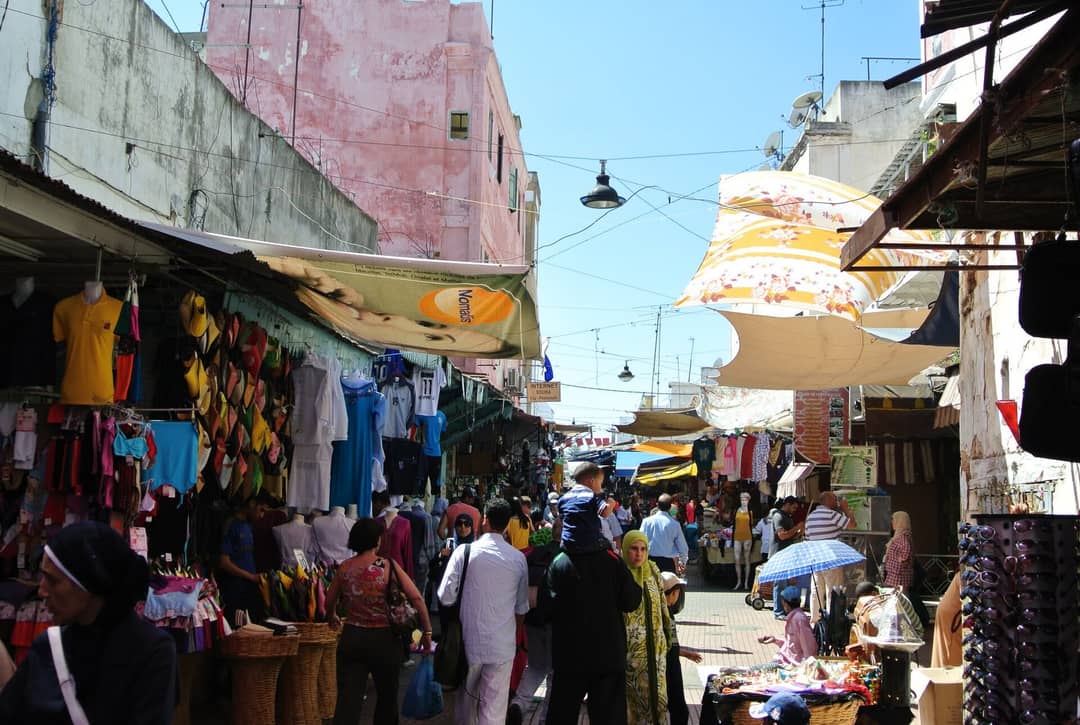
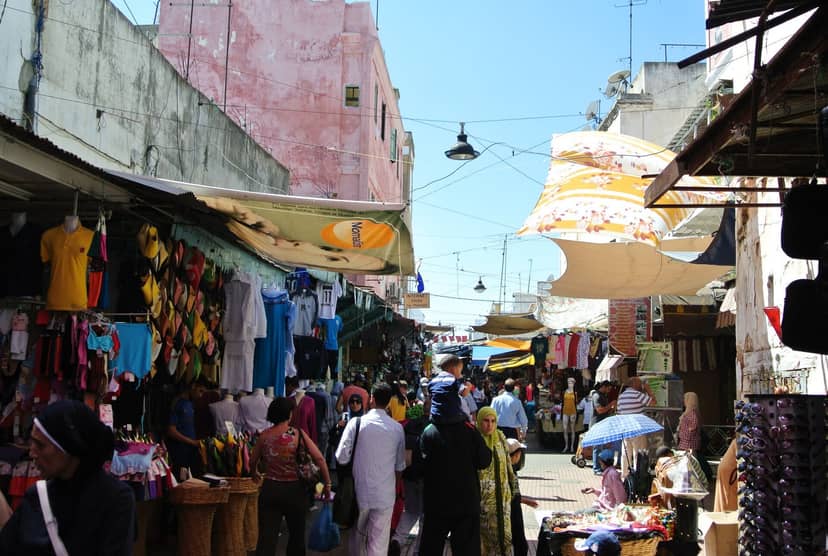
You enter the Mellah of Rabat through Bab Mellah on Avenue Hassan II. The main streets, Rue du Mellah, Rue Rabbin Shalom-Zaoui and Rue David-Cohen, still carry Jewish names, and the quarter is a lively daily market for clothes, household goods and food. Visitors in 2024 and April 2026 described it as safe and busy; one returned in 2026 after 59 years and found his family’s house. The mellah once held more than a dozen synagogues. Most are now private homes or shops and are unmarked, so a guide who knows the quarter makes the difference between a market stroll and a heritage walk.

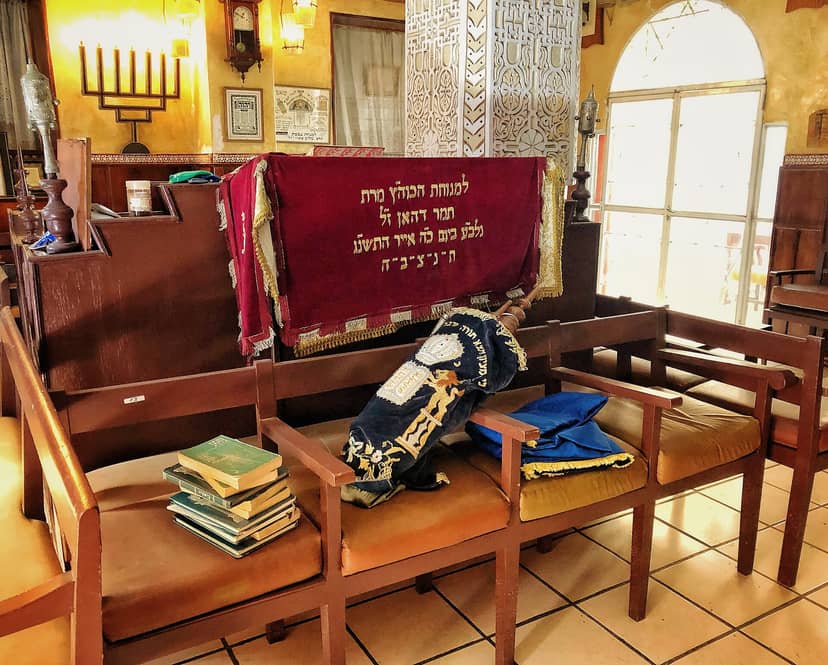
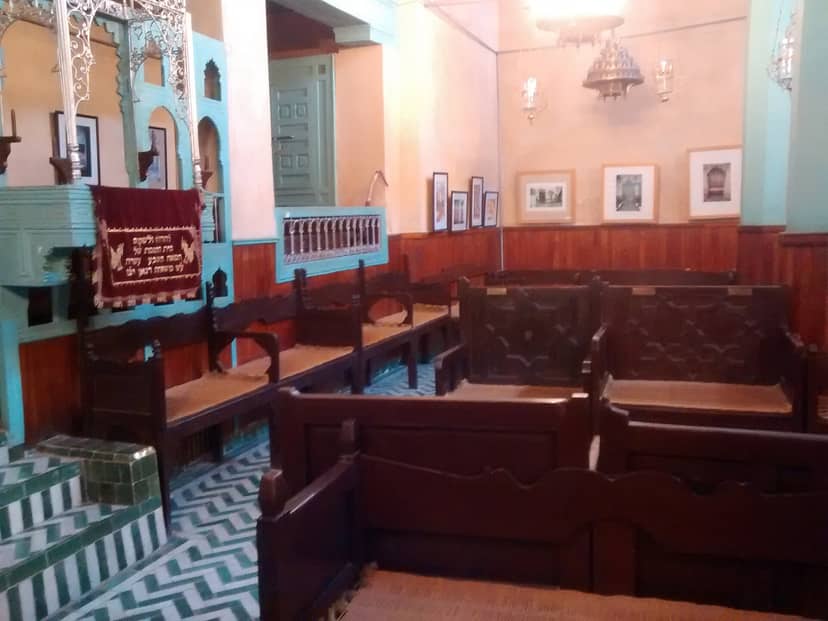
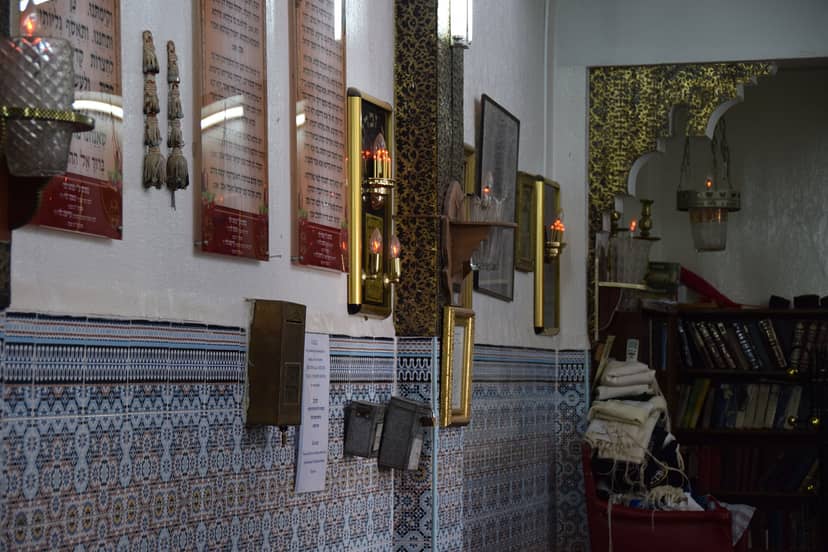
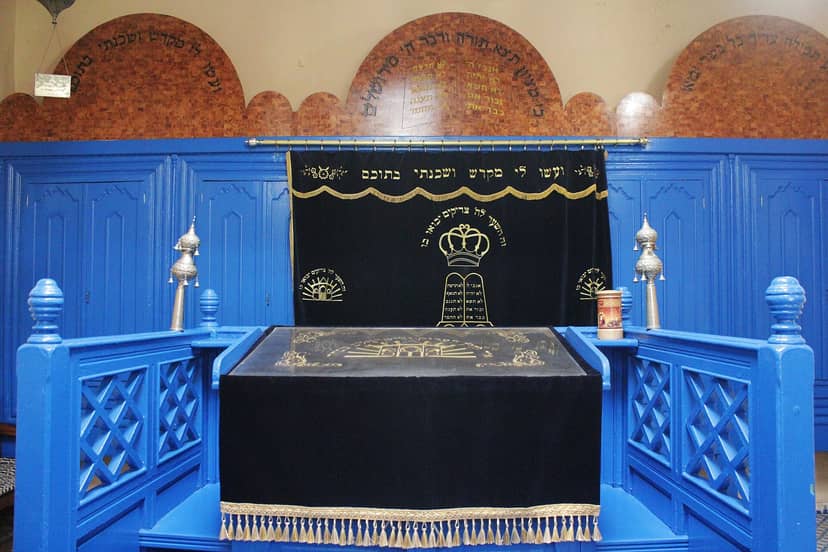
Turn left after the gate and walk towards Bab Diouana to find the Rabbi Shalom Zaoui Synagogue, the one well-preserved synagogue left in the mellah. It was the house of Rabbi Shalom Zaoui (about 1839 to about 1918), remembered as a healer and as the ‘angel’ of Rabat’s community. Large Stars of David mark the door, and inside a bright red courtyard leads to a prayer room in Moorish style, with trilobed windows, mosque-type lamps and zellige tilework. A restoration recorded by Diarna in the 2010s reorganised it around an arcaded courtyard, with a small shrine, a kitchen and a bath. Tradition says the sick who prayed in his synagogue or at his grave were healed, and families still touch the mezuzah (the scroll case on the doorpost) at the entrance.

Access is the delicate part. Services are held mainly at weekends. A visitor in 2016 was let in by a Jewish resident, while another in 2019 was told by a policeman at the gate that it was open only to Jews. We found no 2024–26 report, so we arrange the visit through the Rabat community and treat entry as a request, not a certainty.
Map

Jewish heritage sites: Rabat & Salé

MellahShrineSynagogueCemeteryOther siteLarger pins have their own page. Click the map to zoom with your mouse wheel.

The Jewish cemetery of Rabat and its saints

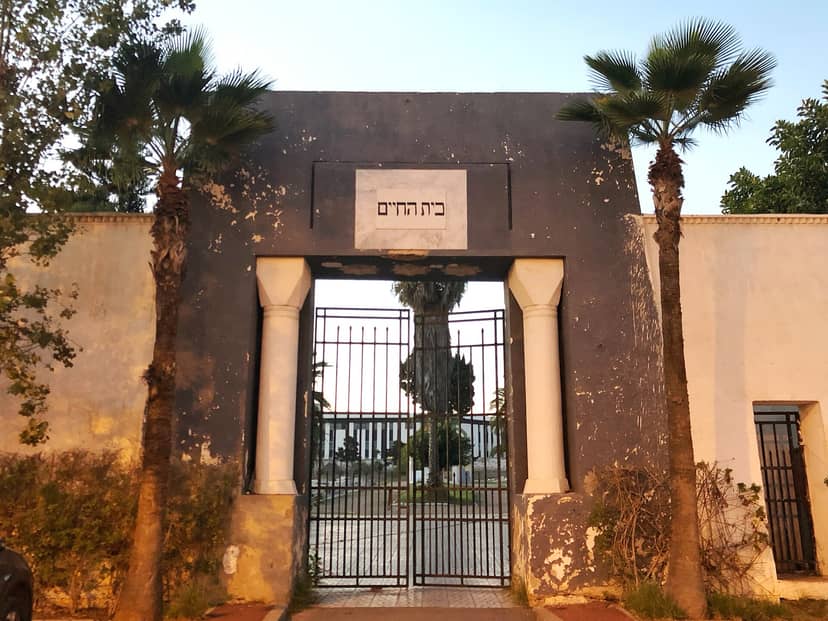
Rabat has two Jewish cemeteries: the old one in the Océan district west of the medina and a newer one on the road to Casablanca beside the Christian cemetery. The old cemetery has inscriptions in Hebrew, French and Spanish, and in 2021 the community’s president said that no tomb there had ever been desecrated.

Two venerated rabbis are buried in its old section. Rabbi Eliezer Davila (1714–1761) was born in Salé to a family whose name comes from Ávila in Castile; his father had come from Meknes. He served as chief rabbi of Rabat, Marrakech and Salé, founded a yeshiva in Rabat and wrote collections of legal decisions and sermons, many published after his death by his son-in-law. His son Mosheh later became chief rabbi of Meknes and then of Rabat. The best-known tradition about him says that during the Lisbon earthquake of 1755 he planted his staff in the sand and stopped the great wave from reaching Rabat. His hilloula, on 3 Adar, the anniversary of his death, drew several hundred people in 2020.

Rabbi Shalom Zaoui, whose house is now the mellah synagogue, is buried here too. His hilloula falls on 29 Kislev, during Hanukkah, and according to Rabbi Menahem Dahan the sick once slept beside his grave hoping to be healed, Muslims among them.

There are no published visiting hours. Outside the hilloulot, we arrange access through the Rabat–Salé community. A short heritage list of saints places both rabbis under Salé, but the community and press reports place them in Rabat.

Salé: the mellah and the tomb of Rabbi Raphael Encaoua

Across the river, Salé’s mellah lies in the old medina near Bab el-Mrissa and Bab Cortoba, which gives access to the quarter. Signage is scarce and few Jews live there today, so it is best seen with a guide. In the old medina, the Lalla Asmae school occupies the former house of Moses Ben Attar and can be seen from outside. A synagogue named after Rabbi Raphael Encaoua was reopened in June 2013 after a two-year restoration, though its exact location and current access still need confirming.

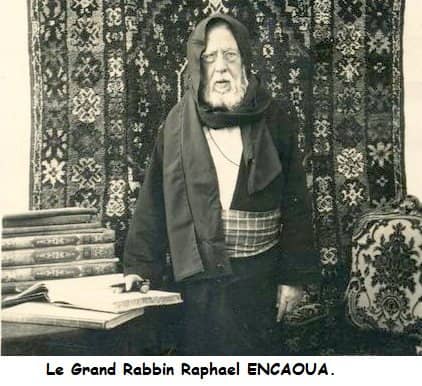
Salé’s most visited Jewish site is the Tomb of Rabbi Raphael Encaoua in the Jewish cemetery on the Meknes road, near the Lycée Plateau. Born in Salé in 1848, he became head of the city’s rabbinical court in 1880, founded a yeshiva there and wrote works of Jewish law. Under the protectorate he was named Grand Rabbi of Morocco in 1912 (by one account) and became the first president of the High Rabbinical Court in 1918. He refused a salary for his religious work, living from modest business affairs, and the historian Michael M. Laskier called him perhaps the most famous rabbi in Morocco of his time; he also set up a fund to place young apprentices in vocational training in Salé. He died on 3 August 1935 (some sources say 1934) and is revered as ‘Malach Raphael’, the angel Raphael. The writer Alan M. Tigay describes his tomb as an octagonal shrine decorated with arabesques and hung with coloured lights.

His hilloula on 4 Av, the anniversary of his death, is one of the major pilgrimages of the Moroccan Jewish calendar; in 2026 it fell on 18 July. Outside the hilloula the cemetery is reached through its guardian or the community. One caution: the map coordinates widely used for this cemetery have not been independently confirmed, so we always go with someone who knows the way.

A Jewish object in Rabat’s archaeological museum

Rabat also holds one of the oldest Jewish objects found in Morocco. Excavations at Roman Volubilis, near Meknes, produced a bronze lamp decorated with a menorah. A 2019 study, which argues that a Greek-speaking Jewish community lived at Volubilis in about the 3rd century CE, places the lamp in the Rabat Archaeological Museum. If the lamp is on display when you visit, it makes a good link between Rabat and the Volubilis inscriptions on a route towards Fes. Ask us to check whether the museum and the object are accessible on your dates.

Where the community is today, and kosher food

Rabat’s Jewish community is small and lives mainly in the new town. The community centre and a newer synagogue are there, and the Rabbi Shalom Zaoui synagogue in the mellah is used mainly at weekends. The community is the right contact for synagogue and cemetery visits, and for the hilloulot.

Kosher food is the weak point. The only kosher restaurant documented in Rabat, Le Cercle, has disappeared from the main listings, which may mean it has closed, and we found nothing dated after 2023. We therefore do not promise kosher meals in Rabat. In practice we organise lunch from a certified caterer in Casablanca, about an hour away, or keep Rabat as a day trip from a Casablanca base where Chabad and kosher restaurants are close by. Vegetarian and fish meals in ordinary restaurants are possible for less strict travellers, with care. Our kosher travel guide explains the options.

Getting there and how many days

Rabat is about an hour north of Casablanca by motorway or train, and Salé is across the river by bridge or tram. One full day covers the mellah, the Shalom Zaoui synagogue and both cemeteries, provided the visits are arranged in advance. Rabat also sits on the road from Casablanca to Fes and Meknes, and on the high-speed line to Tangier, so it fits naturally between the Casablanca and northern parts of a trip.

Avoid Saturdays if you hope to visit the synagogue or cemeteries as a sightseer, and check the Hebrew calendar: a visit timed to one of the three hilloulot is memorable but busy. Dress modestly and carry a head covering. See our sample Jewish heritage tour for how Rabat fits into a longer route.

A day in Jewish Rabat

  1. Morning

    Bab Mellah and the market streets

    Enter through Bab Mellah on Avenue Hassan II and walk Rue du Mellah and Rue Rabbin Shalom-Zaoui with a guide who can point out former synagogues and family houses. The quarter is compact and easy on foot.

  2. Late morning

    Rabbi Shalom Zaoui Synagogue

    Visit the synagogue near Bab Diouana, arranged in advance with the community. Allow 30 minutes; not on Shabbat.

  3. Lunch

    Packed kosher lunch

    A caterer’s lunch brought from Casablanca, or a vegetarian meal for travellers who do not keep strict kashrut.

  4. Early afternoon

    Jewish cemetery of Rabat

    A short taxi ride to the Océan district for the tombs of Rabbi Eliezer Davila and Rabbi Shalom Zaoui, by arrangement. If the Archaeological Museum is open and the Volubilis lamp is on show, it can be added here.

  5. Late afternoon

    Salé: mellah and the tomb of Rabbi Raphael Encaoua

    Cross the Bou Regreg to Salé, see Bab el-Mrissa and the old Jewish quarter, pass the Lalla Asmae school, then visit Rabbi Encaoua’s tomb on the Meknes road with the guardian. Return to Casablanca in about an hour, or continue to Meknes or Fes the next day.

More places for roots travellers

Smaller mellahs, cemeteries and shrines, often in villages. Many need a local contact to visit; we arrange that when we plan your route.

Mellah of Salé

Mellah · Salé · Open to visitors

Salé, across the Bou Regreg from Rabat, had its own mellah in the old medina beside the great Marinid sea gate, Bab el-Mrissa, also called Bab Mellah. The city was a centre of Jewish learning and the birthplace of Rabbi Raphael Encaoua and Rabbi Eliezer Davila. Little is signposted today, so the quarter is best walked with a guide.

Visiting: Public streets of the old medina, open at any time. Little signage; a guide is advisable.

Rabbi Raphael Synagogue, Salé

Synagogue · Salé · Access to confirm

A Salé synagogue named after Rabbi Raphael Encaoua, restored over two years under the Council of Jewish Communities of Morocco and reinaugurated in June 2013 after more than fifty years without maintenance. The press report of the reopening is muddled about its namesake, and its exact location and current access need confirming before a visit.

Talmud Torah Synagogue, Rabat

Synagogue · Rabat · Access to confirm

One of Rabat’s community synagogues, pictured among the city’s Jewish sites by the Visiting Jewish Morocco project and still listed in a local business directory. Its history and access are undocumented, so treat it as a stop to arrange through the community.

House of Moses Ben Attar (Lalla Asmae School), Salé

Heritage · Salé · Seen from outside

One of Salé’s oldest schools occupies the former house of Moses Ben Attar, a Jewish diplomat under Sultan Moulay Ismail who negotiated a treaty with Britain and was appointed leader (naqib) of Morocco’s Jews. It is a working school, so it is seen from outside unless a visit is arranged.

Kosher food & Jewish services

Kosher places open and close often. “To confirm” means we found no recent proof it is operating; we check every listing again when we plan your trip.

Rabat

  • Le Cercle Rabat (kosher restaurant)

    Kosher meat restaurant attached to the Rabat Jewish community club, the only kosher dining option documented in the capital.

    To confirm

Rabat & Salé: common questions

Can I go inside the Rabbi Shalom Zaoui synagogue?

Often, but not always. It is an active synagogue used mainly at weekends, and visitor reports range from a warm welcome to being told it was open only to Jews, so we arrange the visit through the community in advance.

Is there kosher food in Rabat?

None that we can confirm for 2026. We bring meals from a certified caterer in Casablanca or plan Rabat as a day trip from a Casablanca base.

When are the hilloulot in Rabat and Salé?

Rabbi Eliezer Davila on 3 Adar, Rabbi Shalom Zaoui on 29 Kislev, both at Rabat’s old cemetery, and Rabbi Raphael Encaoua on 4 Av in Salé (18 July in 2026).

Can I visit Rabbi Encaoua’s tomb outside the hilloula?

Yes, by arrangement with the cemetery guardian or the Rabat–Salé community. There are no published opening hours.

Is Rabat a day trip from Casablanca?

Yes. It is about an hour by motorway or train, and one well-arranged day covers both Rabat and Salé.

Which Rabat cemetery are my relatives likely to be in?

Older family graves and the saints’ tombs are in the old cemetery in the Océan district; 20th-century burials may be in the newer cemetery on the road to Casablanca. We ask the community to help locate a grave, but cannot promise records exist.

Can you help me find my family’s house in the mellah?

We can try with an address, a street name or old photographs, and a guide who knows the quarter. Many houses have changed hands and street numbers have changed, so we cannot promise to find a specific house.

Sources. Diarna; Yabiladi; Wikipedia; Hespress (2021); North Africa Post (2020); Ville de Salé; Visiting Jewish Morocco (moroccanjews.org); tsidkat-eliaou.org; Morocco World News (2013); MDPI Arts (2019); JewishGen CDP. Researched and fact-checked by Gateway2Morocco, October 2026. Access to religious sites changes; we confirm every visit when we plan your trip.

Photo: Ben Bender / Wikimedia Commons, CC BY-SA 3.0

Brahim Jounh, founder of Gateway2Morocco

Brahim Jounh

Founder · guiding since 1999

Your Morocco specialist

Plan Jewish Rabat & Salé with us

Private trips designed around your family’s story: the synagogues and mellahs, a grandparent’s town, a hilloula date, kosher meals and Shabbat-friendly pacing. Tell us your dates and what matters most.

“Everything was seamless from start to finish”
Lisa S. · May 2026 · TripAdvisor

★ 4.9 on TripAdvisor · 300+ reviews · BC Consumer Protection Licence #80460