How the quarter took shape
Unlike Fes, Marrakech, Meknes or nearby Tetouan, Tangier had no enclosed Jewish quarter, only an unwalled district where Jewish families clustered. In the Beni Idder quarter, synagogues gathered along a short lane that came to be called Rue des Synagogues. Jewish families also owned property across much of the city.
From 1492 Tangier was one of the ports where Jews expelled from Spain came ashore; local tradition links the name of a river, Oued Lihoud (“river of the Jews”), to their crossing. Like the community of Tetouan, Tangier’s Jews spoke Haketia, a Judeo-Spanish vernacular mixing Spanish, Hebrew and Arabic.
The community grew after Tangier became an international zone in 1923, to about 15,000 in the 1920s and about 17,000 in 1955. By one estimate it peaked at around 22,000. Most families then emigrated, to Canada, Israel, the United States and Europe. Estimates of today’s community range from about 60 to about 75 people.
Walking the quarter today
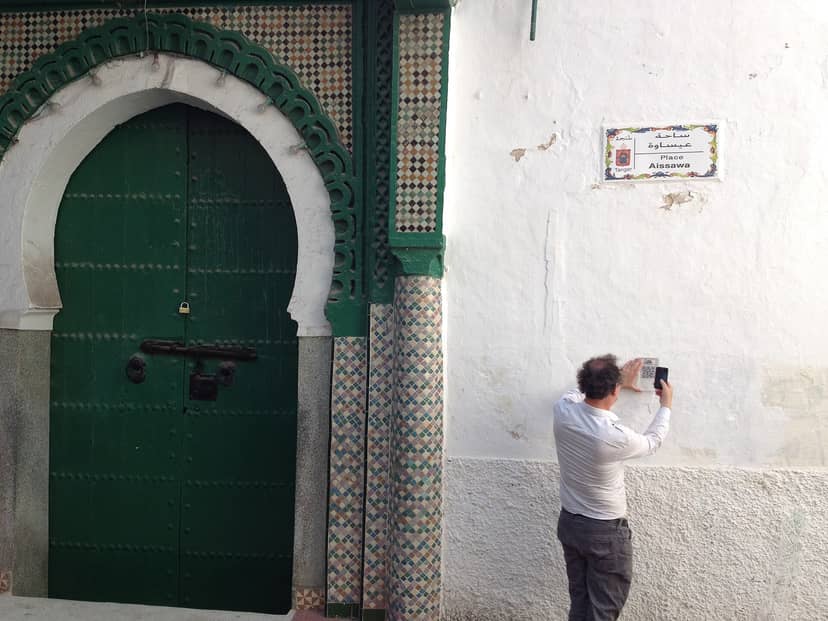
The quarter is a set of ordinary medina streets, and the Jewish past shows in details rather than in a single monument. Rue des Synagogues is a short alley lined with former places of worship, several of them restored. Rue Es-Siaghine, the old main street running down to the Petit Socco, holds several more.
Look out for the communal ovens of the old medina, where families once sent their Shabbat dishes, such as skhina and dafina, to cook overnight; each pot carried a mark identifying its family. In 2021 the community welcomed a royal decision to restore Hebrew names to some Tangier streets.
Synagogues and sites inside
Sources disagree on how many synagogues Tangier once had: 16, 17 or more than 20. One count says seven survive. The main ones for visitors are:
Moshe Nahon Synagogue. A 19th-century synagogue in a dead-end off Rue des Synagogues, restored in 1994 and now a museum with carved stucco, silver lamps and a women’s gallery of embroidery and ketubot.
Rabbi Akiba Synagogue. The smaller of the two medina synagogues kept as museums, built in the mid-19th century and rebuilt in 1912, with a women’s balcony.
Beit Yehuda Museum. The former Assayag synagogue of 1890, opposite Dar Niaba, reopened in 2022 as a museum of northern Moroccan Jewish memory.
Bengio Synagogue and Lorin Foundation. The Mordechai Bengio synagogue is listed among the old synagogues of the Rue Es-Siaghine area, and the Lorin Foundation, a museum of photographs and documents on 20th-century Tangier, occupies a former synagogue on the same street. Some sources identify the two as the same building and others describe them separately, so ask your guide which building you are seeing.
Most interiors are opened by the community or a guide; see each place’s page for access.
Visiting tips
The streets are public and can be walked at any time; allow half a day to see the synagogues and the cemetery properly. Because the museum synagogues have no published opening hours, it is worth arranging a guide who knows Jewish Tangier and can open doors through the community. Dress modestly inside synagogues, and men should cover their heads. Plan the walk for a weekday rather than Shabbat or a Jewish holiday.
Beyond the quarter
Just outside the medina walls, between Rue du Portugal and the sea, lies the old Jewish cemetery, with graves inscribed in Hebrew, Spanish, Portuguese and French. Above it, the American Legation museum has shown an exhibit on the customs and costumes of Sephardic Morocco. In the Ville Nouvelle, Shaar Raphael on Boulevard Pasteur is the city’s one functioning synagogue. Our Tangier and Tetouan guide adds Tetouan, almost 40 miles away, and Asilah.
Tangier Jewish Quarter: questions travellers ask
Does Tangier have a mellah?
No. Unlike most Moroccan cities, Tangier never had a walled mellah; Jewish families lived mainly in the lower medina around Rue des Synagogues and Rue Es-Siaghine.
Can I walk the Jewish quarter on my own?
Yes, the streets are public. To see inside the synagogues you will need a guide or an arrangement with the Tangier Jewish community, as there are no published opening hours.
How many synagogues are left?
Sources vary, but one count says seven of the city’s historic synagogues survive. Shaar Raphael is the only one with regular services; the medina synagogues are museums.
How long do I need?
Half a day covers the main synagogues and the old cemetery at an unhurried pace.
Sources. moroccanjews.org; Aujourd’hui le Maroc; Le Journal de Tanger (2022); New York Jewish Travel Guide (2021); Hadassah Magazine (2020); JTA (2020); Médias24 (2021); Wikipedia. Researched and fact-checked by Gateway2Morocco, October 2026. Access to religious sites changes; we confirm every visit when we plan your trip.