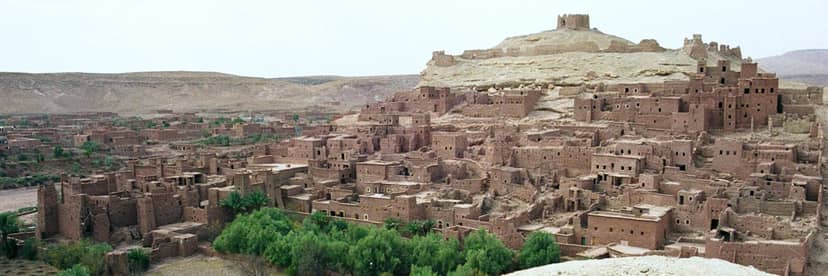
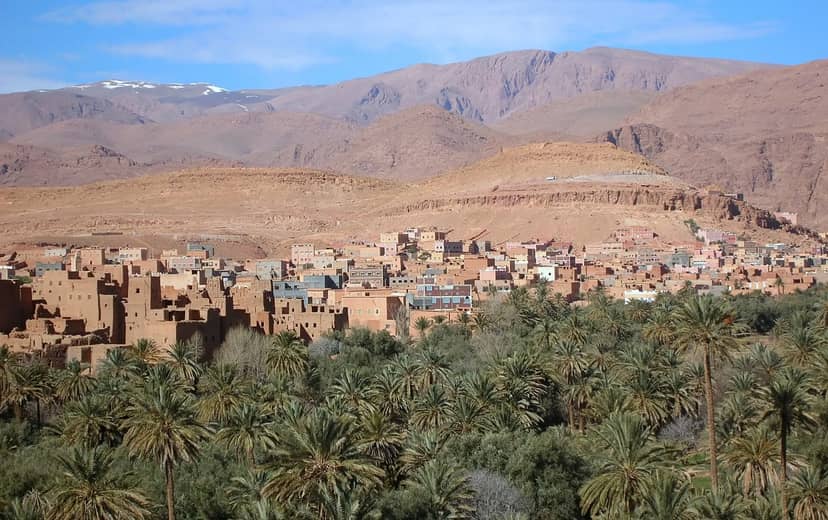
An ancient community, by tradition
Oufrane is widely held to be one of the oldest Jewish communities in Morocco. One tradition derives its name from the Bene Efraim, said to have settled here after the destruction of the First Temple, and holds the cemetery to be about 2,000 years old. These are traditions, and no source we have dates the earliest graves with certainty. The whole community left together in 1958. A synagogue in the abandoned mellah of Ifrane has since been restored.
The martyrs of Oufrane
The cave beside the cemetery is called Me’arat ha-Nisrafim, the cave of the burned. The accounts agree on the core of the story and differ on details.
The oral tradition recorded by Diarna places it in 1790, during the troubled reign of Sultan Mulay Yazid. A local strongman, Bou Halatza, chained 50 Jewish merchants and gave them a choice between conversion and the fire. Tradition holds that the community head, Yehuda Ben-Nathan Effiat, jumped into the flames first and the other 49 followed, and that Jews and Muslims later buried their ashes in the cave.
The University of Haifa project dates the massacre to 1792 and names the pretender Bu Ihlas, who destroyed rural communities in the region and killed scores of Jews, some burned at the stake for refusing Islam. The event is remembered in a Judeo-Arabic lament (qina) and in an Arabic chronicle by Muhammad al-Mukhtar al-Susi. The martyrs are counted among Morocco’s Jewish saints as the “50 Nesrafim”.
What you’ll see
The cemetery sits about a kilometre from the mellah, reached by a narrow path past the old Jewish quarter, above a wadi and below a mountain. Almost every tomb has decayed beyond recognition, and many graves are now a clump of rocks. Among the rubble are broken stones with rough Hebrew engraving, some carrying dates more than 400 years old according to Diarna. An inner section held stones that tradition attributes to antiquity, including one said to be the grave of Eli of Galilee, described as a disciple of Rabbi Shimon bar Yochai. Diarna also notes a purification room near the cave and candle wax left by pilgrims along the trail.
Until the 1950s visitors needed a guide, often the local cantor, and for centuries an inner square of the cemetery was off-limits to Jews.
Visiting respectfully
According to the tradition recorded by the Haifa project, Jews are not supposed to enter the martyrs’ burial place itself. Observant travellers, and Kohanim (descendants of the priestly families, who traditionally avoid cemeteries), should decide in advance how close they wish to go. Wear sturdy shoes, bring water, and do not move or take any stones. See our guide to Jewish heritage in southern Morocco for the rest of the region.
Ifrane Jewish Cemetery and Cave of the Martyrs: questions travellers ask
Is it true that 50 Jews were martyred at Oufrane?
That is the community tradition. Sources differ on the date (1790 or 1792) and on who was responsible, but agree that Jews died by fire rather than convert, and that they were buried here.
Can Jews enter the cave of the martyrs?
Tradition, as recorded by the University of Haifa project, forbids Jews from entering the martyrs’ burial place itself, so plan to keep your distance.
Is the cemetery guarded or locked?
Diarna reports no guard and open access along a footpath. Conditions can change, so we check before your visit.
Do I need a guide?
We recommend one. The path is unmarked and most graves are hard to recognise without someone who knows the site.
Sources. Diarna; University of Haifa, Moroccan Jewish Communities project (Souss); Visiting Jewish Morocco; Wikipedia. Researched and fact-checked by Gateway2Morocco, October 2026. Access to religious sites changes; we confirm every visit when we plan your trip.