Mellah · El Jadida, Portuguese City
The Mellah of El Jadida, Inside the Portuguese City
For more than a century, the walled Portuguese citadel of El Jadida, once called Mazagan, was the town’s Jewish quarter. Jewish families from nearby Azemmour settled inside the ramparts from the 1820s and built a port community with close ties to European trade. The citadel is now part of the UNESCO-listed Portuguese City of Mazagan, an easy place to walk, and from the bastions you can still pick out a former synagogue by the Star of David on its wall.
How the quarter began
The Portuguese held Mazagan for about two and a half centuries, and in that time the fortress had neither a synagogue nor a mosque. Morocco took the town back in 1769, and for decades afterwards it stood largely empty.
In the 1820s Sultan Moulay Abderrahmane ordered the old city restored. New settlers arrived: Jews from Azemmour, Europeans, and farming families from the surrounding Doukkala plain. The Jews settled inside the old walls while Muslims and Europeans built around them, so the citadel itself became the mellah, the Jewish quarter. The Encyclopaedia Judaica records that around 1820, once Jews were allowed to trade at Mazagan, most of Azemmour’s wealthier Jewish families moved here, leaving mainly craftsmen behind.
A trading community
El Jadida grew as an Atlantic port, and its Jewish families were part of that trade. The clearest trace is in the Jewish cemetery beside the Portuguese City, where 19th-century tombstones belong to translators and employees of foreign consulates, people who worked between Moroccan and European business.
Families began to leave in the mid-20th century. In 2019 the Jewish Telegraphic Agency reported that the town no longer has a functioning Jewish community, although its cemetery has been fully restored.
Synagogues inside the walls
The mellah had several synagogues, and the sources do not agree on which name belongs to which building. Yabiladi names Amiel, built in 1860 near the Spanish church, as the quarter’s first religious building, and Maroc Diplomatique calls it the Amiel synagogue, beside the old Spanish church that is now a hotel. It also notes that the Portuguese chapel of Saint-Sébastien served as a synagogue before it became an art gallery. Another heritage guide describes an abandoned synagogue converted from a Portuguese courthouse, with a Star of David visible from the bastions, and labels a photograph “Ben Simon Synagogue”.
What you can see for certain is that Star of David when you look down from the ramparts. We know of no regular access to any of the former synagogue interiors.
Walking the mellah today
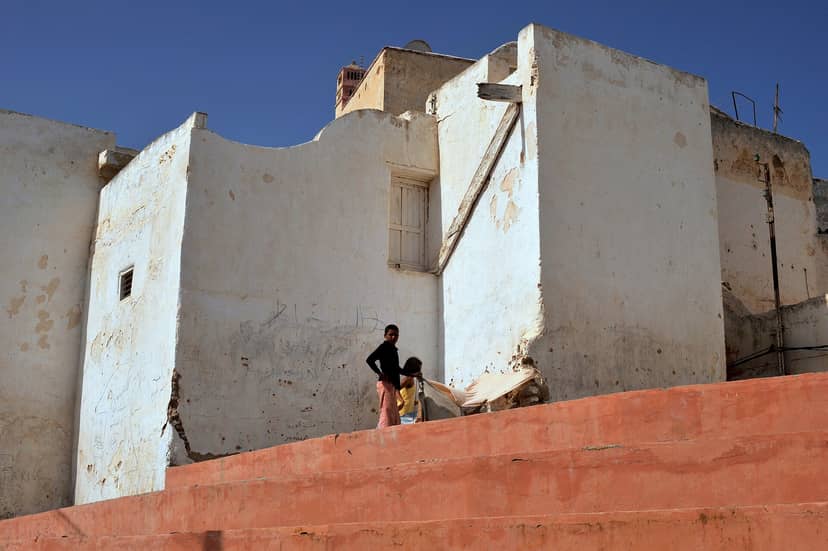
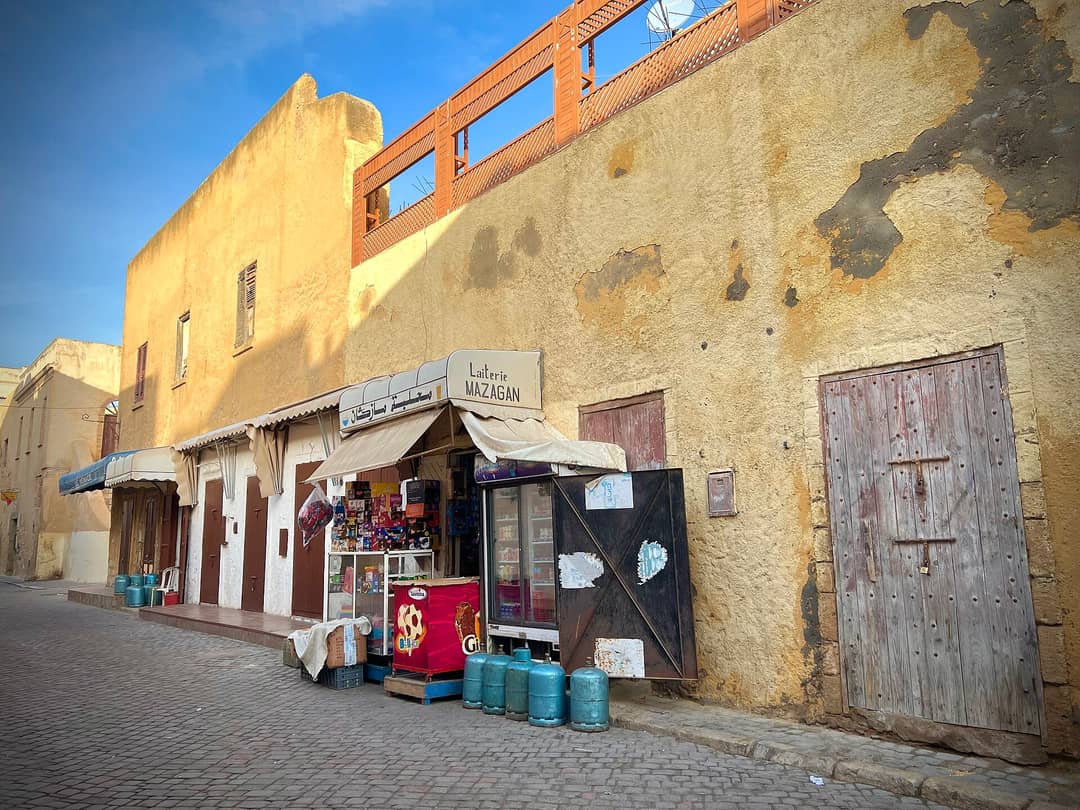
The Portuguese City is compact and free to walk. Its lanes run inside a ring of ramparts, and the two ticketed sights are the walk along the walls and bastions and the vaulted Portuguese cistern. From the bastions you look over the rooftops of the old Jewish quarter, which is the best way to understand how small and close-knit it was.
There is almost no signage about Jewish history inside the walls, so a guide who knows the community’s story makes a real difference here.
Beyond the mellah
The visit pairs naturally with the El Jadida Jewish cemetery next to the walls, and with Azemmour, the town many of El Jadida’s first Jewish families came from, where the shrine of Rabbi Abraham Moul Niss stands in the old mellah. We often plan El Jadida and Azemmour as a single day from Casablanca or as a stop on the way south along the coast; see our guide to Jewish heritage around Casablanca.
Mellah of El Jadida (Portuguese City): questions travellers ask
Is there still a Jewish community in El Jadida?
No. Families began leaving in the mid-20th century, and in 2019 JTA reported that the town no longer has a functioning Jewish community. The Jewish cemetery is maintained and was fully renovated in 2019.
Can I go inside the old synagogue?
We know of no regular access. The building is described as abandoned, and its Star of David is best seen from the ramparts.
Do I need a guide?
Not to walk the Portuguese City, but there is almost no signage on its Jewish history. A guide who knows the community helps you identify the former synagogues and connects the visit with the cemetery and Azemmour.
Can I visit as a day trip from Casablanca?
Yes. El Jadida and Azemmour fit comfortably into one private day from Casablanca, or as a stop on a coastal route south.
Sources. Encyclopaedia Judaica (via Encyclopedia.com); Maroc Diplomatique; Yabiladi; Visiting Jewish Morocco (moroccanjews.org); JTA (2019); JewishGen Cemetery Project. Researched and fact-checked by Gateway2Morocco, October 2026. Access to religious sites changes; we confirm every visit when we plan your trip.