The story
Jews lived in Asilah, the Arcila of older sources, for centuries. When the Portuguese took the town in 1471 they seized 250 Jews and sold them as slaves in Portugal, and Isaac Abravanel ransomed them. After 1492 the port was a landing place for refugees from Spain and Portugal, and a community was established in 1510. When the Portuguese were driven out in the mid-16th century, Jews returned and lived among their Muslim neighbours. In the 19th century the Levy-Bensheton family served as diplomatic representatives of Britain and the United States in the town.
In the early 20th century many families left for South America. About 500 Jews lived in Asilah in 1940, and by 1968 there was no longer an organised community.
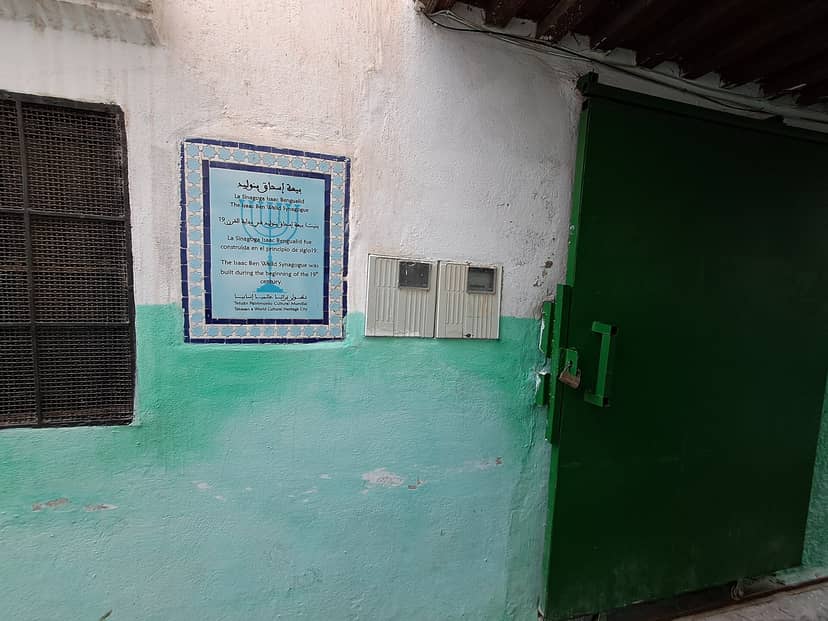
The synagogue was built in 1824 on Al Kharazine street, also called Rue du Commerce, one of the busiest streets of the old town.
The restoration
By the 2020s the building was, in the words of the Tangier community’s vice-president Aaron Abikzer, “completely dilapidated”. The Israelite Community of Tangier led and paid for an eight-month restoration, with support from the regional authority of Tangier-Tetouan-Al Hoceima. Local residents supplied drawings of how the synagogue had looked, and the fittings and pews were remade to match.
The synagogue and the restored mikveh were pre-inaugurated on 6 September 2022, in a ceremony organised by the Council of Jewish Communities of Morocco, the Tangier community and the Foundation for Moroccan Jewish Cultural Heritage. In February 2025 the Ministry of Culture added the synagogue, the cemetery and the mikveh to the national heritage list, at the community’s request.
Inside the synagogue
At the centre stands the wooden tevah, the raised platform from which the Torah is read, restored to its original form. Above it is a wooden ceiling, with traditional lighting. The religious objects come from synagogues in Tangier that have closed, and many of the carpets are old family pieces put back into use.
The walls display artefacts, photographs and marriage certificates recording Jewish life in Asilah. A photograph near the entrance shows the building before restoration, which makes the scale of the work clear.
The mikveh
A mikveh is a ritual bath used for immersion in Jewish law. Asilah’s, built in 1866, was restored at the same time as the synagogue. On the lower floor are two water basins and an old oven that heated the water; upstairs are two bathing rooms under a vaulted ceiling that holds in heat and steam.
Visiting today
A 2025 report describes the synagogue as open to visitors, but no opening hours are published. Visits are arranged through the Tangier Jewish community or a guide, and we set this up when we plan the trip; access should be confirmed close to the date.
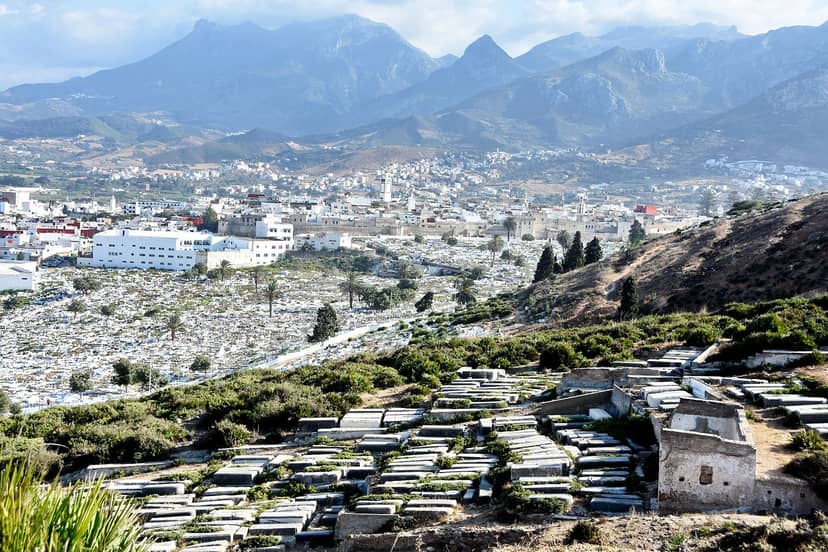
Asilah works well as a stop on the way between Tangier and the Atlantic coast, and the town’s Jewish cemetery is close by. Our Tangier and Tetouan guide covers the wider region.
Kahal Synagogue, Asilah: questions travellers ask
Is the Kahal synagogue still used for prayer?
Asilah has had no organised Jewish community since the late 1960s, and the restored building is presented mainly as a heritage site. We found no published schedule of services.
Do I need an appointment?
Yes. There are no published opening hours, so visits are arranged in advance through the Tangier community or a guide.
Can I see the mikveh as well?
The mikveh was restored with the synagogue and is part of the heritage-listed site; ask for it when the visit is arranged.
Can non-Jews visit?
Yes, respectful visitors of any background are welcome when a visit has been arranged.
Sources. TelQuel (2022); Médias24 (2022, 2025); New York Jewish Travel Guide (2025); Jewish Virtual Library; Atlas Obscura. Researched and fact-checked by Gateway2Morocco, October 2026. Access to religious sites changes; we confirm every visit when we plan your trip.