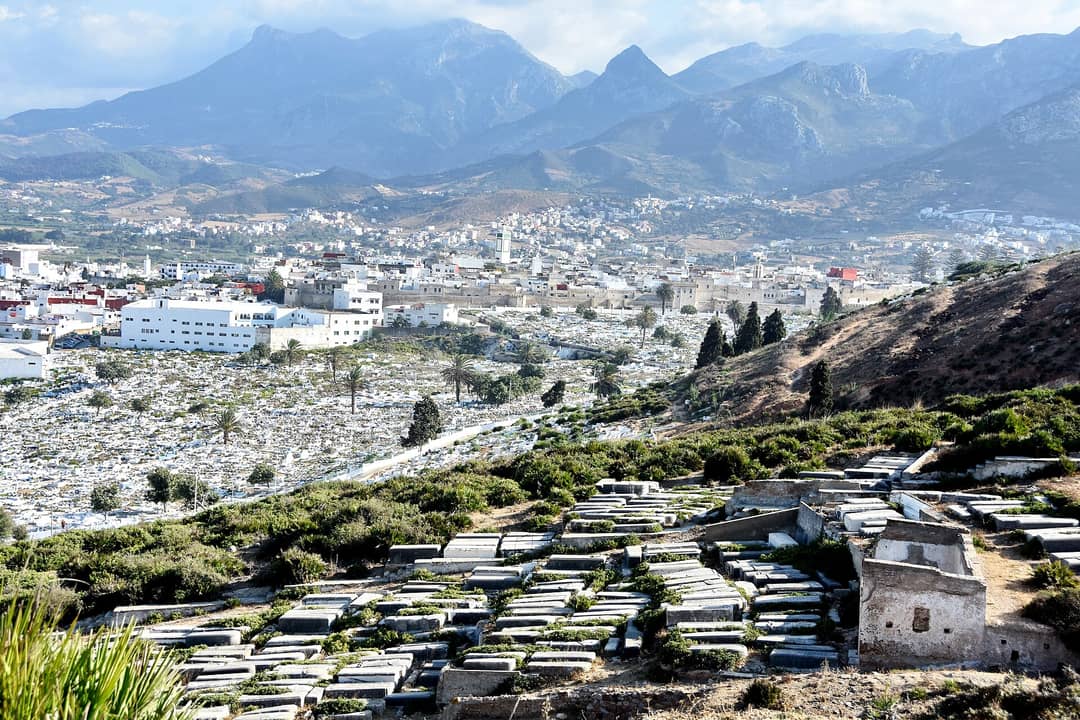
Cemetery · Tetouan, Ceuta road
Jewish Cemetery of Tetouan
The Jewish cemetery of Tetouan covers about 15 hectares of hillside on the north-east edge of the city, beside the Muslim cemetery on the Ceuta road. Probably in use since soon after the 1492 expulsion from Spain, it is one of the oldest and largest Jewish cemeteries in Morocco, with unusual human-shaped tombstones in its oldest section and the whitewashed tomb of Rabbi Isaac Bengualid. The gate is kept locked, so visits go through the guardian.
History
Jews expelled from Spain reached Tetouan as the city was being rebuilt in the late 15th century, and the cemetery was probably opened soon after 1492. The community, formally organised in 1530 under Rabbi Haim Bibas, buried its dead here for the next five centuries. In 1931, after a three-year fundraising campaign among Tetouan’s Jews, a wall was built around the whole site.
Figures for its size vary. Most sources give about 10,000 graves, of which around 1,500 carry inscriptions; one source puts the number of tombstones at about 35,000. Some writers call it the largest Jewish cemetery in Morocco, a title also claimed for the Miaara in Marrakech, so “one of the largest” is the fair description.
What you’ll see
The cemetery climbs a slope. From the entrance a path runs about 100 metres to a fork: to the right is the lower, newer section, still in use, and to the left a narrow path climbs to the older ground.
The oldest area is called the Cementerio de Castilla, after the Castilian exiles buried there; it is also known as the mearah chiquita, the “little cemetery”. Its stones are distinctive. Rather than box-shaped slabs, many are anthropomorphic, roughly following the outline of a human body, and the community counts some of the tombs here among the cemetery’s 16th-century graves. The upper part of this section is steep, sparse and overgrown.
The newer terraces, the mearah grande, hold rows of family tombs cut from solid marble, inscribed in Hebrew and often with the name and date repeated in Spanish. Some of this marble came from quarries in Spain and Italy.
Notable graves
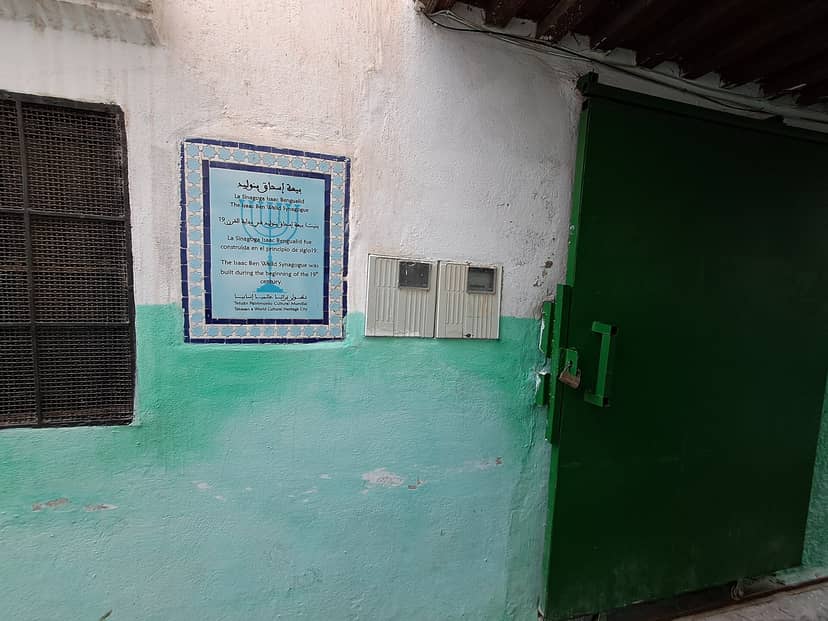
The most visited grave is that of Rabbi Isaac Bengualid (1777–1870), head of Tetouan’s rabbinical court. His tomb is covered in whitewash, with those of his sons Semtob and Vidal on either side, and none of the three carries an epitaph. His annual hilloula is described on the Tomb of Rabbi Isaac Ben Walid page. Rabbis of the Bibas and Jalfón families are also buried here.
Around Purim 2023, Rabbi Joseph Israel, a Tetouan native, showed the community where three sages lay whose graves had been lost for more than 60 years: Jacob Ben Malca, Hasday Almosnino and Jacob Marrache. Jewish law forbids exhuming remains, so it has not been possible to say which tomb belongs to which rabbi. See the Tombs of the Tetouan Sages.
Community tradition also attaches stories to particular spots. The “Piedra Caída”, or fallen stone, is said to have dropped from the sky to protect the grave of a young Cohen killed for refusing to convert; versions differ on his name. Nearby, according to the same tradition, childless women prayed at a small well called “El Pocito”.
Finding a family grave
Many families come here looking for a grandparent or a more distant ancestor, and it takes patience. By local custom, names were often inscribed only for people who left no descendants; families were expected to remember where their elders lay. As a result many stones carry no name at all, and inscriptions in the older sections are increasingly worn.
Most 20th-century graves have been restored, and the community has been working to document the older ones, but we cannot promise that a record exists for any particular grave. Bring every name, Hebrew name and date you have. A guide working with the community and the guardian gives you the best chance.
Visiting respectfully
The main gate is usually padlocked. In 2022 a visitor found a phone number posted on it; there is also a way in through the guard’s house at the end of the wall to the right of the gate. We contact the guardian before your visit.
Wear sturdy shoes, as the old section is steep and uneven. Do not step on graves, dress modestly and leave a tip for the guardian. This is an active cemetery where families still come to pray.
Jewish Cemetery of Tetouan: questions travellers ask
Can you find my family’s grave?
We can try, but we cannot promise it. Many stones carry no name by local custom and older inscriptions are worn; bring every name and date you have and we will work through the guardian and community.
Is the cemetery open every day?
There are no published opening hours. The gate is kept locked and opened by the guardian, so visits are arranged in advance, and it is customary not to visit on Shabbat or Jewish holidays.
Is it the largest Jewish cemetery in Morocco?
It is one of the largest. Some sources call it the largest, the same claim is made for the Miaara in Marrakech, and published size figures vary widely.
Can non-Jewish travellers visit?
Yes, respectful visitors can enter with the guardian. Going with a guide who has called ahead is the easiest way in.
Sources. Maguén-Escudo (Philip Abensour); Ceuta Desconocida; eSefarad (2023); Hespress (2023); Moroccan Jews; New York Jewish Travel Guide (2019). Researched and fact-checked by Gateway2Morocco, October 2026. Access to religious sites changes; we confirm every visit when we plan your trip.