Mellah · Tetouan medina
Tetouan Mellah: The Jewish Quarter of Tetouan
The Tetouan mellah is the planned Jewish quarter that Sultan Moulay Slimane ordered built in 1807, just south of the Feddan square in the medina. For more than a century it was the home of a Haketia-speaking Sephardic community so learned that the city was called “Little Jerusalem”. Very few Jews live in Tetouan today, but the straight lanes, Jewish street names and empty mezuzah recesses still make the quarter easy to read on foot.
How the quarter began
Tetouan was rebuilt at the end of the 15th century by refugees from Granada, and Jews expelled from Spain in 1492 arrived as the new city went up. The community was made up of Spanish exiles (megorashim), and in 1530 Rabbi Haim Bibas organised it formally along Castilian rules and customs. Into the 20th century its everyday language was Haketia, the Judeo-Spanish dialect of northern Morocco.
The first Jewish quarter stood near the Great Mosque. It was plundered by the troops of Sultan Moulay Yazid after 1789, and by a decree dated 5 August 1807 Sultan Moulay Slimane ordered the Jews to move to a new quarter. According to a local history, each family had six months to sell its house to a Muslim buyer and build a new one in the mellah at the same price.
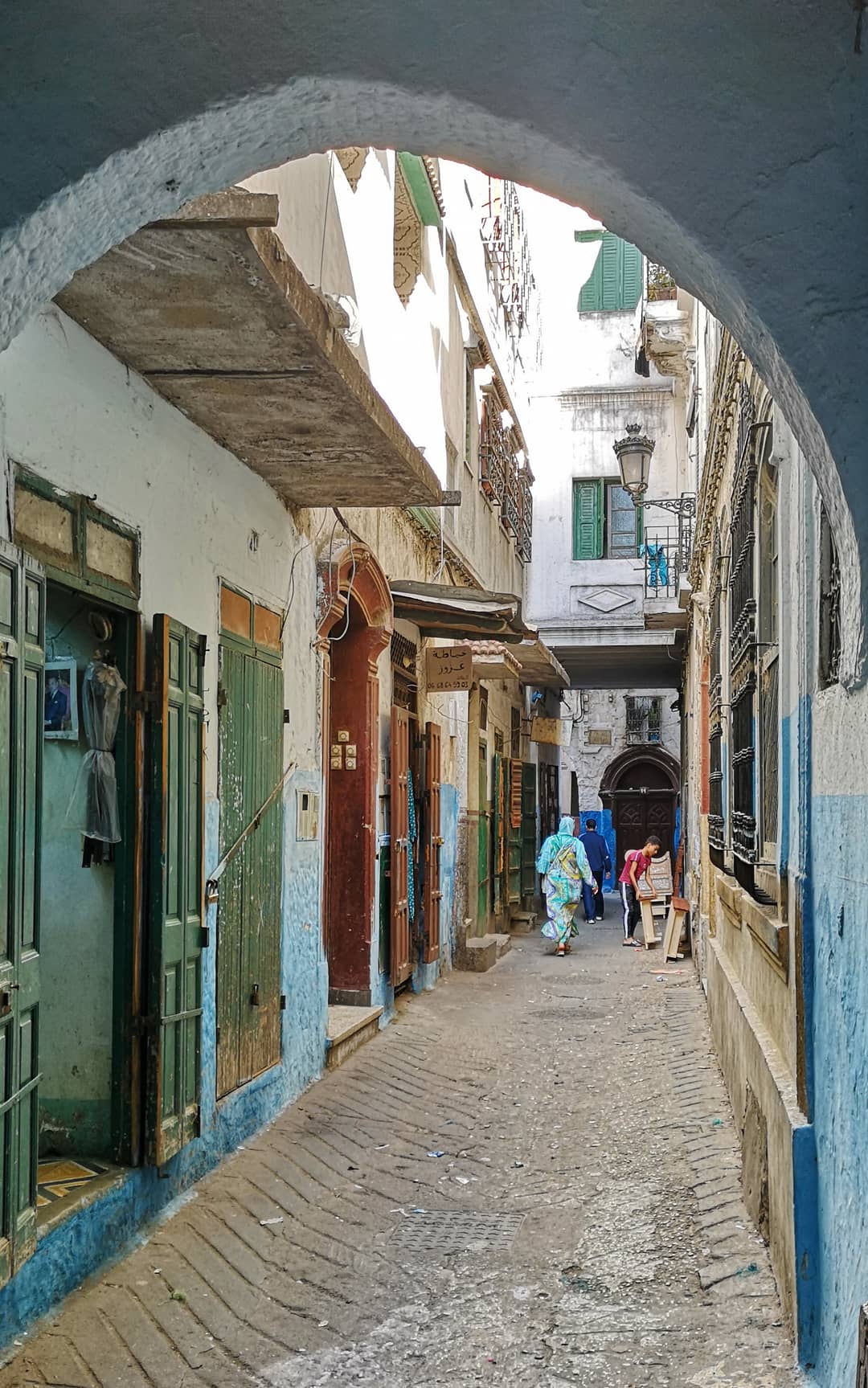
The new mellah was laid out with unusual regularity: narrow but straight streets with whitewashed arches and high doorsteps, entered through only one or two gates. In February 1860, during the Hispano-Moroccan War, the Jewish quarter was looted just before Spanish troops entered the city. Accounts differ on the details; one widely cited figure is about 400 killed. In 1862 the Alliance Israélite Universelle opened its first school in Morocco here, a boys’ school, followed by a girls’ school in 1868.
A community at its height
A 1913 count recorded about 4,200 Jews in Tetouan, almost all of them living in the mellah, in a city of some 18,500 people. The Jewish population of the city peaked at 8,058 in 1940. At the start of the 20th century the quarter had 16 synagogues, among them the Taurel, Benmalcá, Vidal Israel, Maimón, Nahón, La Pintada and Serfaty synagogues.
From 1912 Tetouan was the capital of the Spanish Protectorate. Emigration grew after 1948 and again after independence in 1956, to Israel, Europe, South America and elsewhere. About 3,100 Jews remained in 1960. A 2019 report counted about ten.
Walking the mellah today
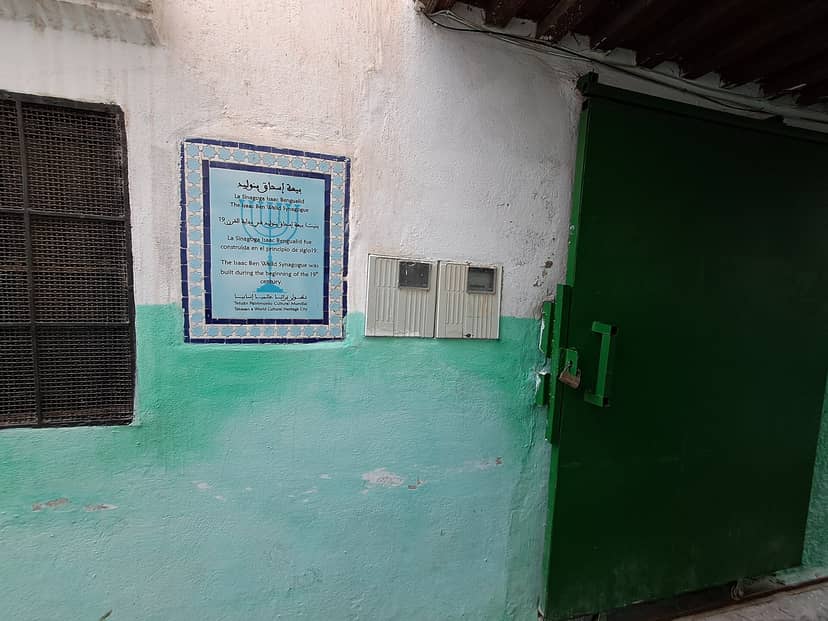
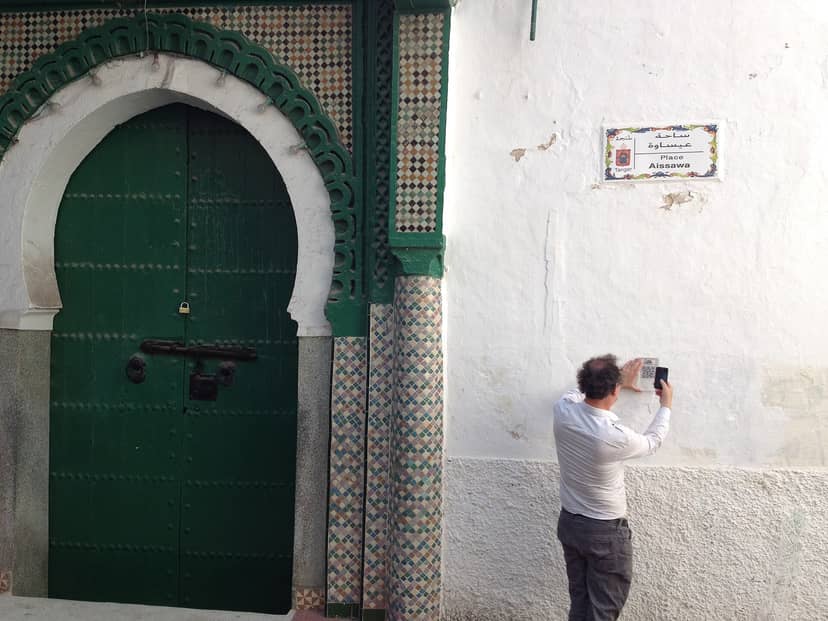
The mellah is a public part of the medina and you can walk it freely. Watch the street signs: several lanes still carry Jewish or Spanish-era names, including Isaac Bengualid, Sultana Cohen, Vidal Serfati, Bentolila, Prado and Dr Angel Pulido.
On many doorframes you will see a small rectangular recess on the right-hand side. This is where a mezuzah was fixed: the small case holding a parchment of Torah verses that Jewish households place on their doorposts.
Most of the old synagogues were sold with the houses around them as families emigrated, and they are now homes or shops with nothing to mark them. What remains is the quarter itself: arched passages, high doorsteps and a regular grid, unlike the winding older medina.
Synagogues and sites inside
The one synagogue described as surviving is the Isaac Ben Walid Synagogue, linked to the rabbi who headed Tetouan’s rabbinical court from 1835 until his death in 1870. It has not held regular services since 1968 and is kept as a museum by the Moroccan Jewish community. It once had its own oven for baking matzah and a small mikveh (ritual bath).
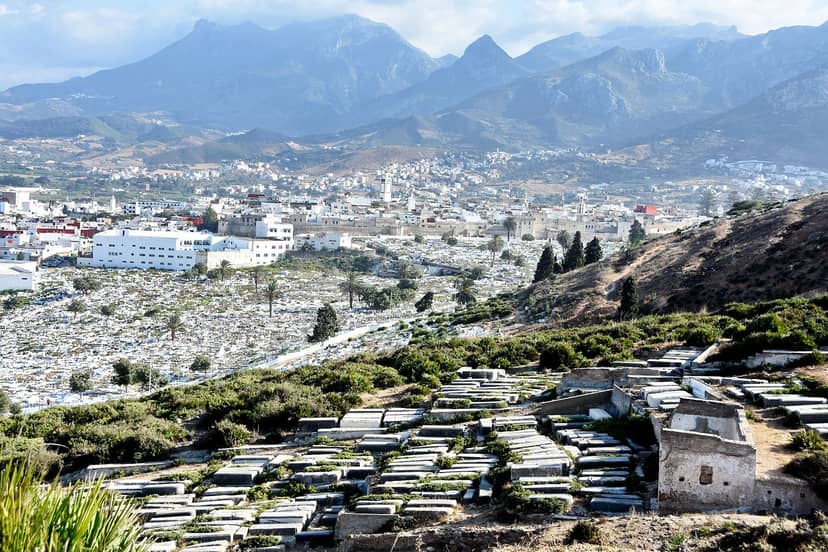
The community’s cemetery lies outside the quarter, on the north-east edge of town by the Ceuta road. The Jewish Cemetery of Tetouan holds the whitewashed tomb of Rabbi Isaac Bengualid and graves going back to the first exiles from Spain.
Visiting tips
A walk through the mellah takes about an hour, longer with a stop at the synagogue. The synagogue opens through a caretaker rather than at set hours, so we arrange the visit in advance when we plan the trip, and access should always be confirmed close to the date.
The lanes are residential. Greet people, ask before photographing anyone, and keep voices low near doorways. Very little is signposted, so a guide who knows the quarter’s history makes a real difference here.
The mellah sits inside Tetouan’s medina, a UNESCO World Heritage Site. Many travellers pair Tetouan with Tangier or Chefchaouen; our Tangier and Tetouan guide covers the region.
Tetouan Mellah: questions travellers ask
Do Jews still live in the Tetouan mellah?
Very few Jews remain in Tetouan at all: a 2019 report counted about ten in the whole city. The houses of the mellah were sold as families emigrated and the quarter is now home to Moroccan Muslim families.
Can I visit the mellah without a guide?
Yes, the streets are public. A guide helps you find the Jewish street names, mezuzah marks and former synagogue sites, and can arrange the synagogue visit with the caretaker.
Why was Tetouan called Little Jerusalem?
The nickname reflects the city’s role as a centre of Sephardic rabbinic learning in Morocco from the 16th century onward. Older sources also call it the “Jerusalem of Morocco”.
Can you help me find where my family lived?
Sometimes. With an old address or street name, a knowledgeable guide can often find the spot on the ground, but we cannot promise that records survive. Tell us everything you know when we plan the trip.
Sources. Wikipedia (Jewish community of Tétouan); Maguén-Escudo; Ceuta Desconocida; New York Jewish Travel Guide (2019); Diarna. Researched and fact-checked by Gateway2Morocco, October 2026. Access to religious sites changes; we confirm every visit when we plan your trip.