Who he was
According to Yabiladi, Eliezer Davila was born in Salé in 1714. His father, Samuel de Avila, had come from Meknes, which the family reportedly left because of heavy taxation. At fifteen he married the daughter of Rabbi Elijah Halevi of Salé.
He went on to serve as chief rabbi of Rabat, Marrakech and Salé, and founded a yeshiva (a Torah academy) in Rabat that drew students from the region. He wrote a collection of legal rulings, a collection of sermons and a book on Jewish law and custom; many of his works were published after his death by his son-in-law. His son Mosheh became chief rabbi of Meknes and later of Rabat. Rabbi Eliezer died in 1761, aged 47, and was buried in Rabat’s old Jewish cemetery.
The traditions about him
Two stories are told about him, and both belong to tradition. The best known concerns the great Lisbon earthquake of 1755: tradition holds that when the sea rose towards Rabat, the rabbi planted his staff in the sand and the waves stopped there. The scholar Issachar Ben-Ami records a version in which the sultan stood beside him.
Another story, told in the book Men of Faith, says he learned some months in advance that he would die within the year, and received the news calmly, saying he had fulfilled his mission in the world.
The hilloula
A hilloula is the annual gathering at a tzaddik’s grave (a tzaddik is a righteous person revered as a saint) on the anniversary of his death. Rabbi Eliezer Davila’s falls on 3 Adar, the date of his death, which lands in February or March. In a Hebrew leap year, when there are two months of Adar, confirm with the community which one is observed.
In February 2020 several hundred people gathered at the cemetery, including pilgrims from elsewhere in Morocco and abroad. They sang liturgical and Judeo-Moroccan songs, prayed for the King and the late kings, and asked for rain in a drought year. We can build a Rabat stay around the date; see our guide to hilloula pilgrimages in Morocco.
Visiting outside the hilloula
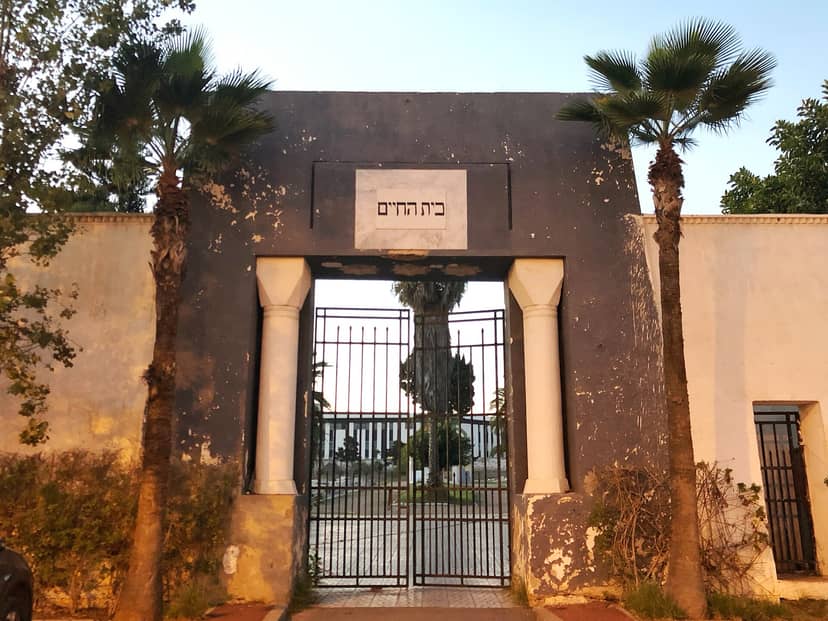
The tomb is inside the old Jewish cemetery in the Océan district, so it follows the cemetery’s access, which is arranged through the Rabat-Salé Jewish community. No public opening hours are published; we request access when we plan your days in Rabat. Many visitors light a candle or say a prayer at the tomb. Dress modestly and avoid walking over graves.
Rabat or Salé?
Because he was born in Salé, one widely used saints’ list places Rabbi Eliezer Davila under Salé. Yabiladi and North Africa Post both place his grave in Rabat’s Jewish cemetery, and that is where his hilloula is held.
Tomb of Rabbi Eliezer Davila: questions travellers ask
When is Rabbi Eliezer Davila’s hilloula?
On 3 Adar on the Hebrew calendar, which falls in February or March. We confirm the exact date with the community each year.
Is the story about the 1755 tsunami true?
It is a tradition about the rabbi, not a documented event. It is told by writers such as David Bensoussan and Issachar Ben-Ami as part of his legend.
Can I visit the tomb on a normal day?
Yes, by arrangement. There are no published hours, so we ask the Rabat-Salé community for access in advance.
Sources. Yabiladi; North Africa Post (2020); Visiting Jewish Morocco. Researched and fact-checked by Gateway2Morocco, October 2026. Access to religious sites changes; we confirm every visit when we plan your trip.