History
Debdou’s Jewish families, many of them kohanim of priestly descent, traced their roots to refugees from Seville after the persecutions of 1391. For centuries they formed a large part of the town’s population; the story of the community is told on our Debdou mellah page.
The old cemetery served the community for most of that time, and tradition dates it back some 900 years. According to one community history, an inscription there records a legend of Judeans, Levites and kohanim being settled in Andalusia in antiquity. The newer cemetery, a little further up the hill, was opened in the early 20th century, and its graves date up to the mid-1950s, as the community dwindled through emigration.
What you’ll see
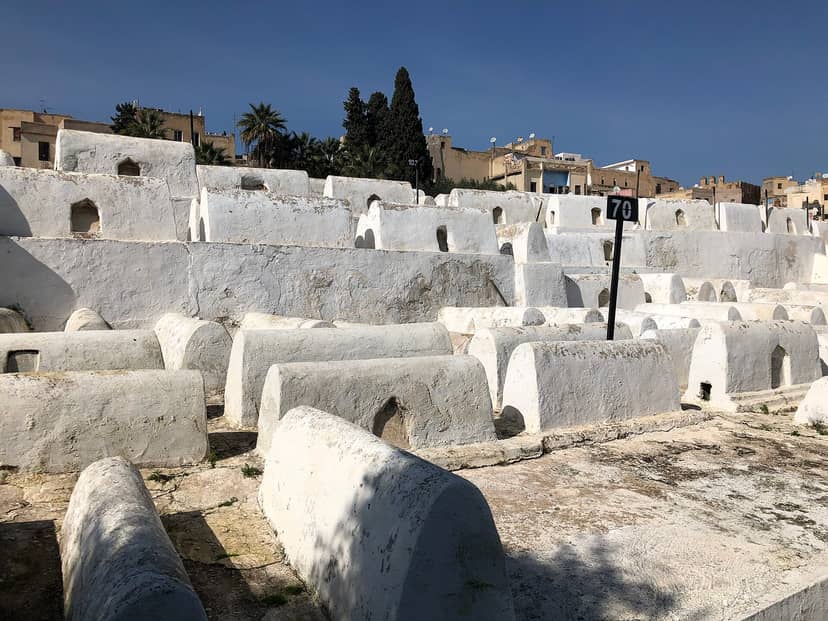
In the old cemetery, graves are marked by plain stones roughly the length and width of a coffin, with no engravings. A survey in 2002 found its mud wall largely worn away, though the metal gate survived.
The newer cemetery has several hundred graves. Inscriptions are painted or engraved in cement, many in Hebrew and several in Spanish, a reminder of the community’s Sevillian origins. The graves of the tzaddikim are marked by small hearth-like niches.
Saints associated with Debdou include Youssef Bensimon, Jacob Cohen, Ishak Ben Moche Cohen, Mardochee Ben Moche Cohen and Moche Ben Sultan, several of whom are honoured with annual hilloulot (pilgrimages on the anniversary of a saint’s death). Our sources do not say which saint lies in which cemetery.
Pilgrims and visitors
Local Muslim residents report that Jewish groups come from time to time to visit family graves or pray at the saints’ tombs. In 1992 almost seventy French Jews of Oujda origin made the pilgrimage together.
We have not found confirmation that these cemeteries were included in the national restoration programme of the 2010s, nor any current information on a caretaker. Our most detailed description of their condition dates from 2002, so we check the present state before including them in a trip.
Visiting respectfully
The cemeteries are a short climb above the town, so wear sturdy shoes. Dress modestly, keep off the tombs, and ask permission before photographing graves: these are still places of prayer for families and pilgrims. A local guide who knows the paths is the best way to find the saints’ tombs. For timing your visit around a pilgrimage, see our hilloula guide.
Debdou Jewish Cemetery: questions travellers ask
Are there two Jewish cemeteries in Debdou?
Yes. The old cemetery, said to be about 900 years old, lies on the hill above town, and the newer one, used from the early 20th century to the mid-1950s, is further up the slope.
Which saints are buried here?
Saints associated with Debdou include Youssef Bensimon, Jacob Cohen, Ishak and Mardochee Ben Moche Cohen and Moche Ben Sultan. Sources do not say which cemetery each lies in.
Can I find a family grave?
Stones in the old cemetery carry no inscriptions, so identification there is rarely possible. In the newer cemetery many inscriptions survive, and a local guide can help you search, without guarantees.
When are the hilloulot?
Several saints are honoured each year, but we have not found published dates. Ask us and we will check with the community.
Sources. JewishGen International Jewish Cemetery Project (2002); moroccanjews.org; New York Jewish Travel Guide (2026); Torah-Box. Researched and fact-checked by Gateway2Morocco, October 2026. Access to religious sites changes; we confirm every visit when we plan your trip.