Who she was
According to the French epitaph on her tomb, Solica Hatchuel was born in Tangier in 1817. She was the daughter of Haim and Simha and the younger sister of Yissachar; her father and brother were merchants.
Much of what is known comes from an account published in 1837 by a writer named Romero, based on interviews with her family and other witnesses. In his telling, a Muslim neighbour encouraged her to convert and then told the pasha (governor) of Tangier that Solica wished to become a Muslim. Solica denied it, and is reported to have said: “I was born a Hebrew and a Hebrew I desire to die.” Treated as an apostate from Islam, she was confined, offered wealth and marriage, then imprisoned and chained when she refused.
The pasha sent her to Fes to be judged under Sultan Moulay Abd al-Rahman. The qadi (judge) there condemned her, and she was publicly beheaded in 1834. The Hebrew epitaph gives the year 5594 and calls her “the righteous Solica Hagouel”.
Different versions of the story
Accounts disagree on several points. One version says the rabbis consulted during her imprisonment advised her to pretend to convert to save her life; another says they urged her to stay faithful. Some accounts say a son of the sultan offered to marry her if she converted; others speak of a forced marriage to a prince. We tell the story as the sources do, with its uncertainties.
Her memory
Sol Hachuel became a symbol of faithfulness for Moroccan and Sephardic Jews. Novels, poems, ballads and stage plays have retold her story in several languages. Many scholars believe the French painter Alfred Dehodencq’s Execution of a Jewish Woman in Morocco was inspired by her death.
At the tomb, Jewish families light candles and pray, as they have for generations. Arab and Berber Moroccans who call her Lalla Solica believe her tomb can bring healing and fertility, and come for those reasons. That shared veneration of a Jewish saint by Muslim neighbours is part of what makes the grave so striking to visit.
The tomb
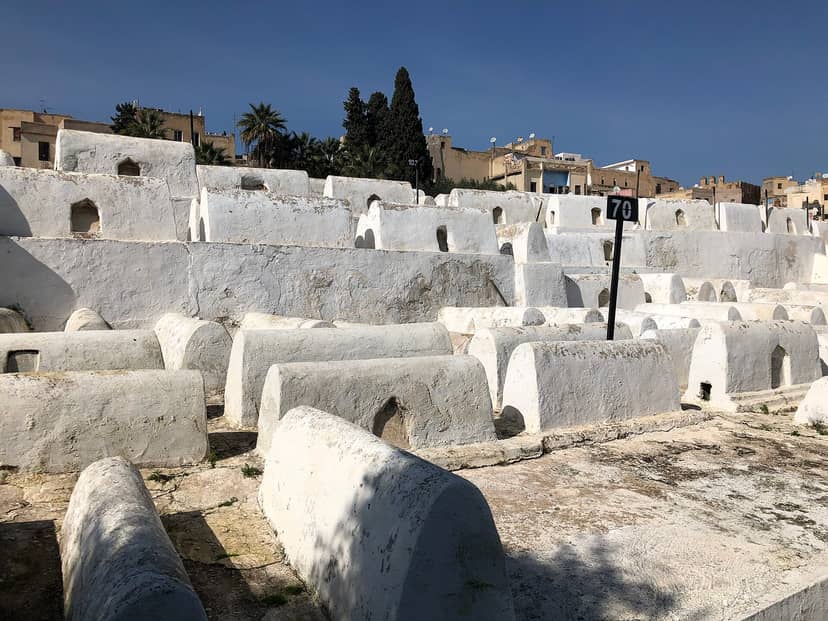
The tomb is easy to find with the caretaker’s help: a blue-tinted structure with a horseshoe arch, topped by a bright green roof and three small vase-shaped turrets, set among the cemetery’s white graves. Its French and Hebrew epitaphs can both be read. Candles are often left burning at its foot.
Visiting
The tomb is inside the Jewish Cemetery of Fes, on the edge of the mellah, and follows the cemetery’s access. Entry is free and a caretaker is on site; listed hours of 7am to 7pm daily are undated, so we confirm them when we plan your trip. The sources found do not record a fixed annual hilloula for her. Dress modestly, keep to the paths, and leave a pebble or light a candle if you wish. Our Fes Jewish heritage guide shows how the cemetery fits into a day in the mellah.
Tomb of Lalla Solica (Sol Hachuel): questions travellers ask
Who was Lalla Solica?
Sol Hachuel, a Jewish girl born in Tangier in 1817 and executed in Fes in 1834 at 17 for refusing to convert to Islam. Jews call her Sol the Righteous; Muslims call her Lalla Solica.
Why do Muslims visit her tomb?
Many Arab and Berber Moroccans believe her tomb can bring healing and fertility, and venerate her as a saint.
Is there a hilloula for Sol Hachuel?
The sources we found do not record a fixed annual hilloula for her, though visitors pray at her tomb throughout the year.
Is the story historically accurate?
Her birth, execution in 1834 and burial are recorded on her tomb, but accounts differ on details such as the advice she received and whether a marriage was offered.
Sources. Aish; Morocco World News (2020); GPSmyCity. Researched and fact-checked by Gateway2Morocco, October 2026. Access to religious sites changes; we confirm every visit when we plan your trip.