Synagogue · Fes mellah
Slat al-Fassiyin Synagogue, Fes Mellah
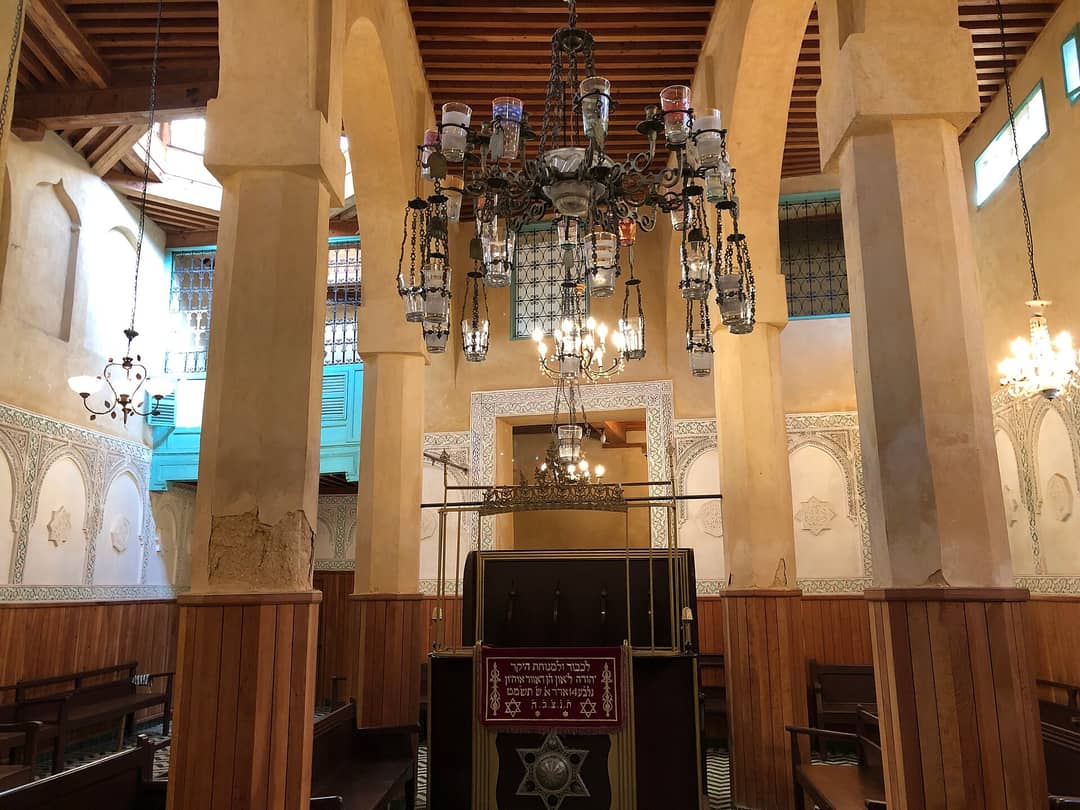
Slat al-Fassiyin, the “prayer of the people of Fes”, was the synagogue of the toshavim, the Jews who lived in Fes before the Spanish exiles arrived, and it kept their older rite into the 20th century. After decades as a carpet workshop and a boxing gym it was restored and reopened in 2013. Inside is one of the largest prayer halls in Fes, with arcades, zellij, carved stucco and a women’s gallery.
The story
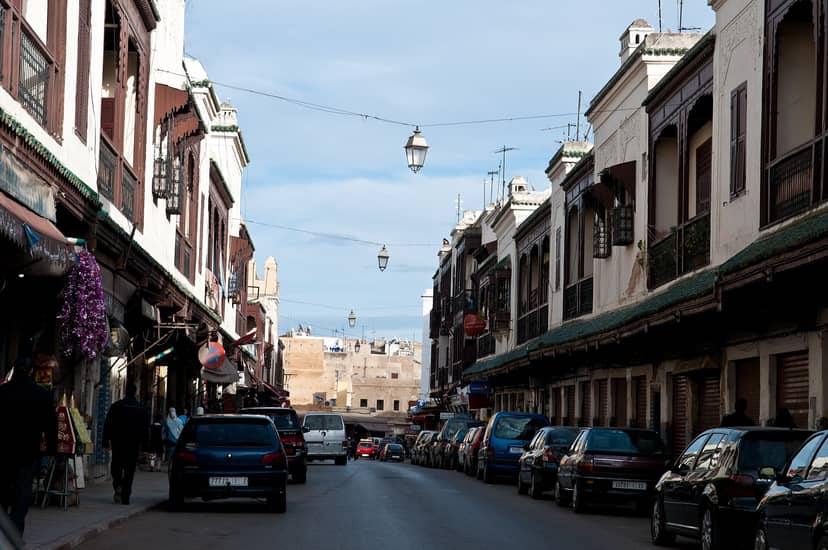
The synagogue stands in the oldest part of the mellah, on what Hespress calls the quarter’s oldest lane. It is often described as the oldest synagogue in the mellah, but its age is disputed. The historians Susan Gilson Miller, Attilio Petruccioli and Mauro Bertagnin date its founding to before 1492, because it preserved rituals older than the Spanish exile; the art historian Michelle Huntingford Craig dates it to the 17th century. Hespress says it is reputed to go back to the Marinid period, with the present building from the 17th century, while Wikipedia says it was probably rebuilt after 1792.
Its congregation were toshavim, Judeo-Arabic and Judeo-Berber-speaking Jews long settled in Fes, as distinct from the megorashim, the exiles from Spain who arrived after 1492. Their prayer differed from the Andalusian rite, and this was one of the few synagogues in Morocco where it survived into the 20th century.
In 1790 Sultan Moulay Yazid expelled the Jews from the mellah and the synagogue became a prison until his death in 1792, when the community returned. It stayed in use until most of the community emigrated, to Israel, France and Montreal among other places, from the late 1950s. It closed in 1970 or 1971 (sources differ) and was later used as a carpet workshop and then a boxing gym. Hespress reports that a Muslim caretaker kept the interior intact through those years and lit a candle there every Friday.
Restoration and reopening
The two-year restoration was led by Simon Lévy, former secretary general of the Foundation for Moroccan Jewish Cultural Heritage, and carried out under royal patronage. Funding came from the German government, the Jewish community of Fes, the Foundation and the Moroccan state; a plaque at the lane entrance credits the German Foreign Ministry and the Fondation Jacques Toledano. The synagogue was reinaugurated in February 2013 by Prime Minister Abdelilah Benkirane, with more than 200 guests including the president of the German parliament.
Inside the synagogue
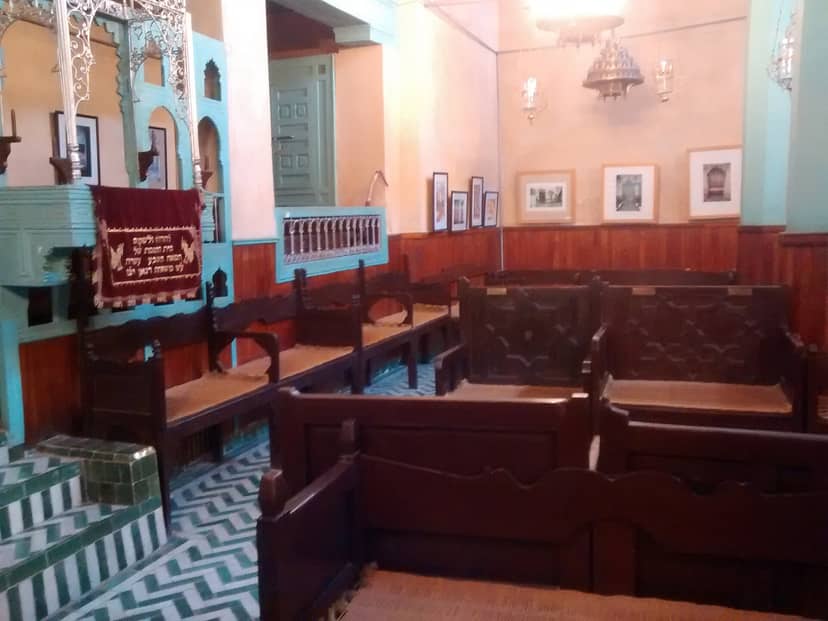
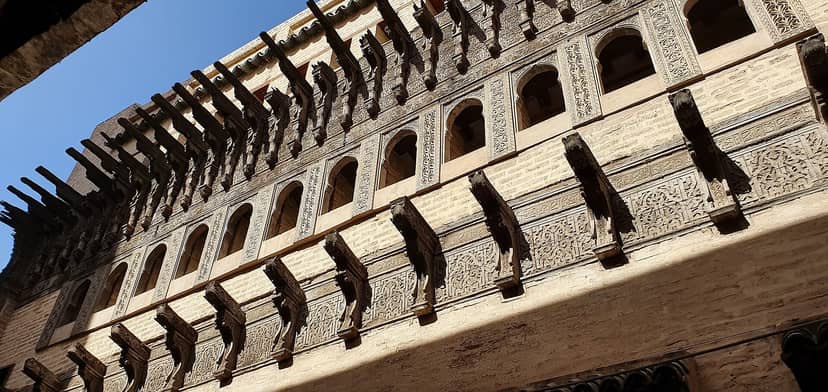
The hall measures about 7.3 by 11.5 metres, one of the largest synagogue interiors in Fes. Two rows of three pillars carrying pointed arches divide it into three aisles, and two octagonal skylights and high windows light it from above. The lower walls are faced with polychrome zellij (Moroccan tilework) and the upper walls with carved stucco in vegetal and star patterns, and the floor is a wavy green-and-white mosaic. A horseshoe-arched niche stands near the entrance.
The tevah, the reading platform, is in the centre of the hall. The heikhal, the ark for the Torah scrolls, originally stood on one of the long walls and has since been moved. At one end a staircase rises to the women’s gallery. Old wooden benches and oil-lamp cups survive, along with the rabbi’s place for prayer and a Torah scroll.
Visiting today
Since the restoration the synagogue has been kept as a prayer hall with an on-site supervisor rather than a museum, and in 2021 Hespress described it as a favourite stop for Jewish visitors, especially families from Fes. It is not regularly open to the public, and no opening hours are published. We arrange access through a guide or the Fes community when we plan your trip; please treat any visit as subject to confirmation.
Nearby in the mellah
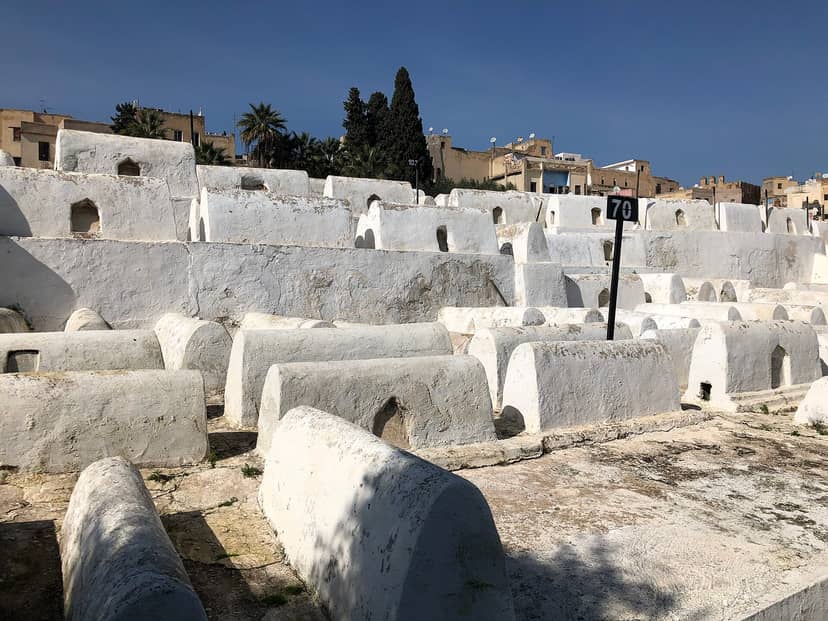
The Ibn Danan Synagogue is a short walk away, and the Jewish Cemetery of Fes and Rue des Mérinides are close by. Our Fes Jewish heritage guide puts them all on one walking route.
Slat al-Fassiyin Synagogue: questions travellers ask
Is Slat al-Fassiyin the oldest synagogue in Fes?
It is often called the oldest in the mellah, but historians disagree: some date its founding before 1492, others to the 17th century.
Can I just walk in?
Usually not. It is not regularly open and has no published hours, so we arrange access ahead of your visit.
Is it a museum?
No. It was restored as a prayer hall and is looked after by a supervisor. The small museum near the cemetery is a separate building.
Who were the toshavim?
The Jews settled in Morocco before the 1492 expulsion from Spain, who spoke Judeo-Arabic or Judeo-Berber and kept their own rite, distinct from that of the Spanish exiles.
Sources. Wikipedia (Al Fassiyine Synagogue; Mellah of Fez); Hespress (2021). Researched and fact-checked by Gateway2Morocco, October 2026. Access to religious sites changes; we confirm every visit when we plan your trip.