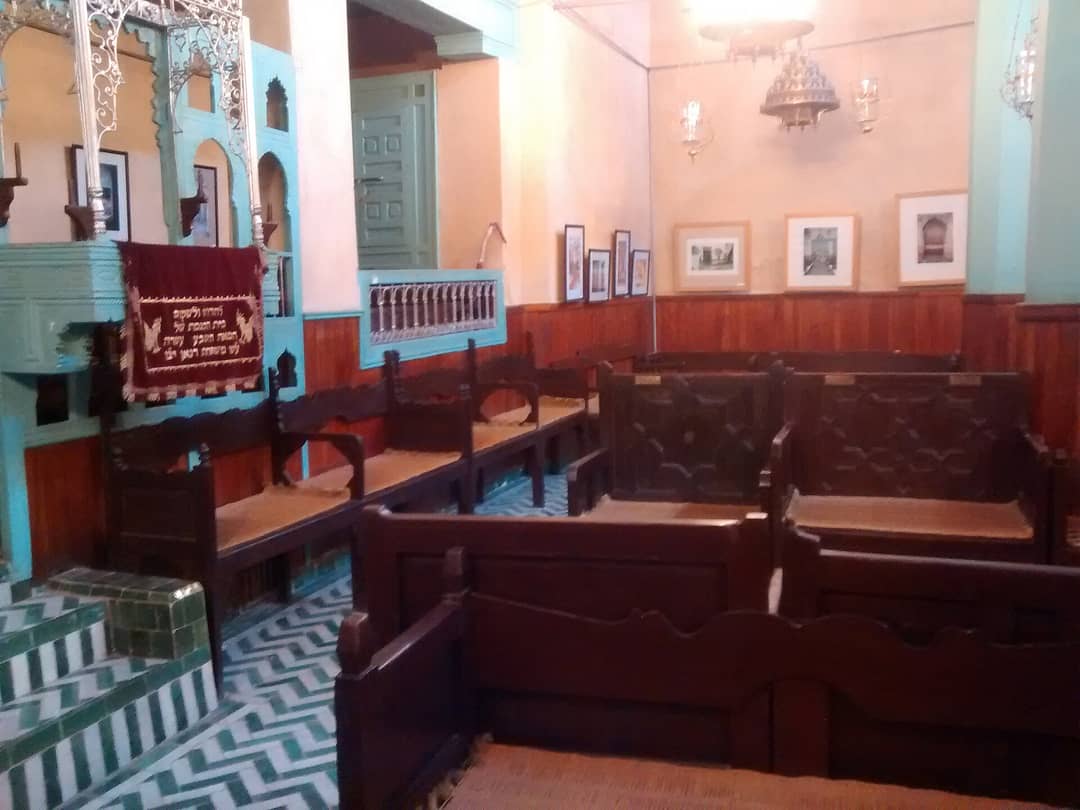
Synagogue · Fes mellah
Ibn Danan Synagogue, Fes Mellah
The Ibn Danan Synagogue is a 17th-century synagogue in the lower part of the Fes mellah, restored in the late 1990s and reopened in 1999. Behind a plain door that looks like any house entrance is a tall prayer hall with its carved Torah ark, a raised tevah under a wrought-iron canopy, and a ritual bath found below the floor during the restoration. A guardian shows visitors around.
The story
Sources disagree on exactly when it was built. Most place the first synagogue on the site in the 17th century, early or late; the historian Hicham Rguig gives 1680. The art historian Michelle Huntingford Craig writes that an earlier building was destroyed in 1646 and the present one completed by 1701.
Tradition credits a wealthy merchant, Mimon Boussidan, one of the notables of the toshavim (the Jews established in Morocco before the Spanish expulsion of 1492), with building it. Unlike many Fes synagogues, which were rooms in private houses, it was built as a place of prayer from the start.
The building was probably damaged in the persecution of 1790, when the community was forced out of the mellah for two years, and was repaired afterwards; another restoration took place in the 1870s. From 1812 every rabbi of the synagogue came from the Ibn Danan family, whose roots are traced to 15th-century Granada, and it is named after Rabbi Shlomo Ibn Danan, who led it in the early 20th century. Wikipedia records that it closed in the 1960s, as most of the Fes community emigrated.
In 1996 the Jewish community nominated it to the World Monuments Watch, which reported peeling plaster, collapsing roofs, waterlogged beams and broken windows. The restoration was funded by American Express and carried out with Morocco’s Ministry of Culture and the Judeo-Moroccan Cultural Heritage Foundation, and the synagogue reopened in 1999.
Inside the synagogue
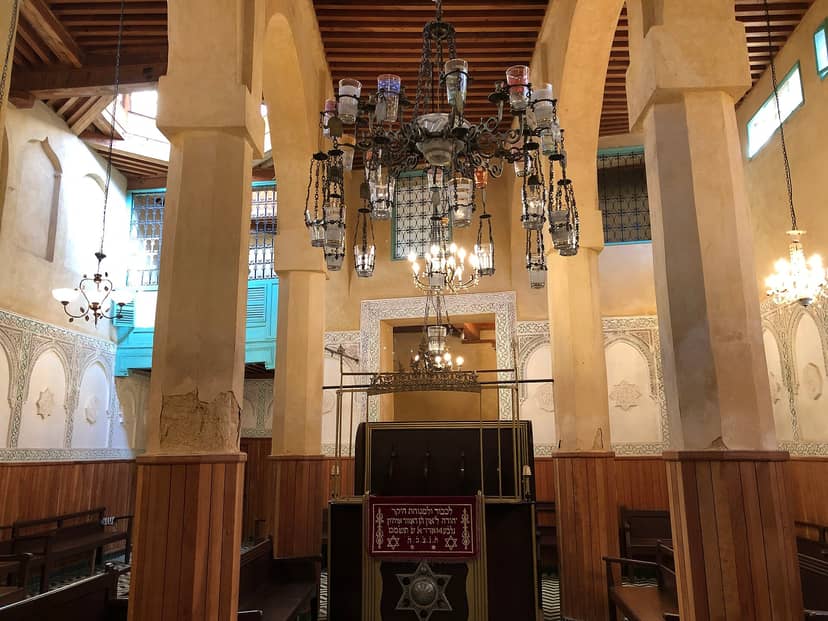
A short staircase leads from the street door into a high rectangular hall divided by a row of three pillars. Light comes from small windows set high in the walls. The beamed wooden ceiling is painted, and the lower walls are lined with blue patterned zellij (Moroccan tilework). Photographs from 1954 show the ceiling hung with memorial lamps, which have since gone.
The heikhal, the ark that holds the Torah scrolls, is a carved wooden cupboard filling the width of one wall, with finely carved plaster above it. Opposite stands a raised alcove for the congregation’s leading members, screened by a row of carved wooden arches. From it projects the tevah (the reading platform, called bimah elsewhere), a small wooden platform under a wrought-iron canopy of arches and floral forms topped by a crown. There is a balcony for women.
During the restoration in 1997, workers found a vaulted chamber beneath the tevah. Stairs lead down to a mikveh, a ritual bath, with a square basin fed by an underground water channel. Ask the guardian to show you.
Visiting today
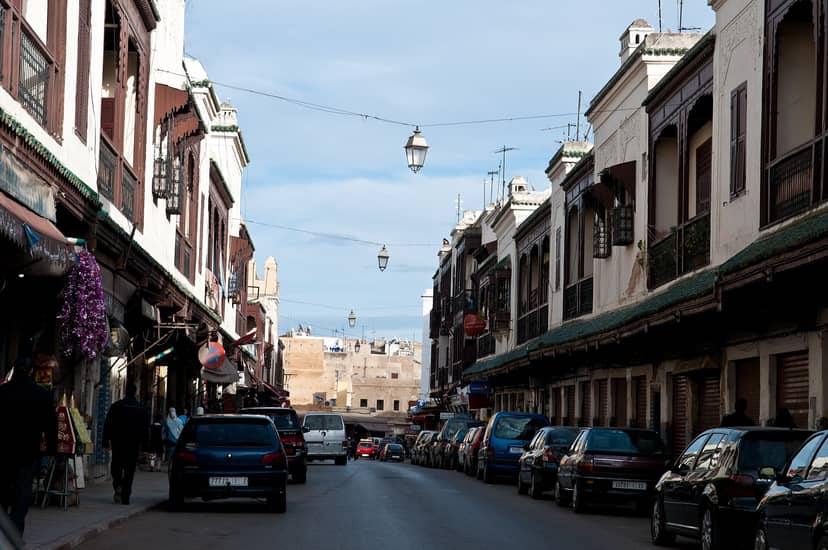
The synagogue is on Derb Djaj, a lane running south off Rue des Mérinides roughly halfway along it, and can also be reached from the cemetery side. It stands against the outer wall of the mellah. A guardian lets visitors in and points out the main features, and a tour operator reported in August 2025 that it was open to visitors through the week, with hours that vary by season. It is still used for prayer on the High Holy Days.
Because hours are not published, we confirm access, including Saturday and Jewish-holiday closures, when we plan your Fes days. A tip for the guardian is customary.
Etiquette
Dress modestly, with shoulders and knees covered. Men should cover their heads; bring a kippah or a cap. Ask before taking photographs, and do not photograph during prayer.
Nearby in the mellah
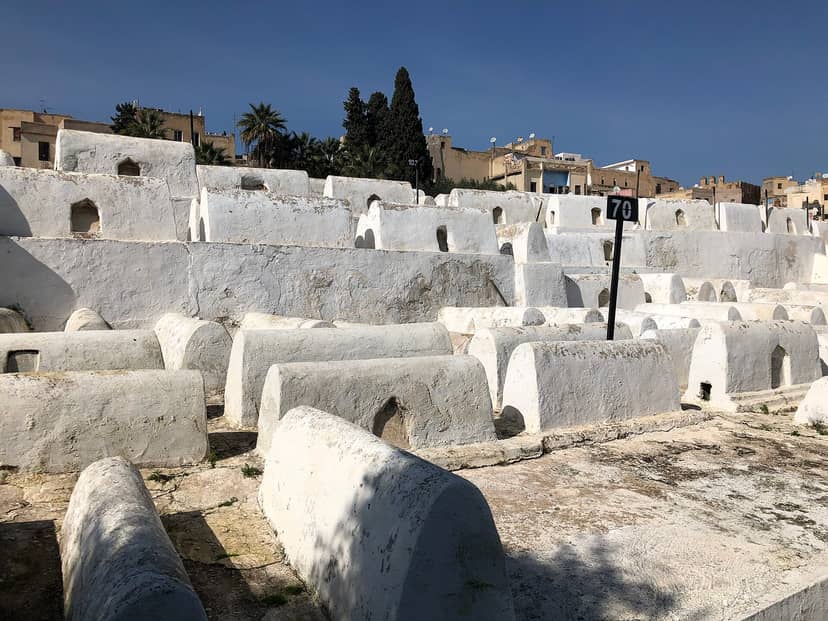
The Slat al-Fassiyin Synagogue is a short walk away in the same quarter, and the Jewish Cemetery of Fes is close by. Most travellers see Ibn Danan as part of a half-day walk through the Fes mellah with a guide who knows its Jewish history; our Fes Jewish heritage guide covers the rest of the city.
Ibn Danan Synagogue: questions travellers ask
Can non-Jews visit the Ibn Danan Synagogue?
Yes. The guardian welcomes visitors of any background who dress modestly and behave as they would in any house of prayer.
Is it open on Saturday?
Access on Shabbat and Jewish holidays is not confirmed, so we plan your visit for a weekday and check with the guardian beforehand.
Is it still an active synagogue?
It is still used for prayer on the High Holy Days. Few if any Jews live in the mellah today, so there are no regular services.
Do I need a guide?
Not to enter, but the lanes of the lower mellah are hard to navigate and a guide who knows the Jewish history makes the visit far more rewarding.
Sources. Wikipedia (Ibn Danan Synagogue; Mellah of Fez); World Monuments Fund; Lonely Planet; Mint Tea Tours (2025). Researched and fact-checked by Gateway2Morocco, October 2026. Access to religious sites changes; we confirm every visit when we plan your trip.