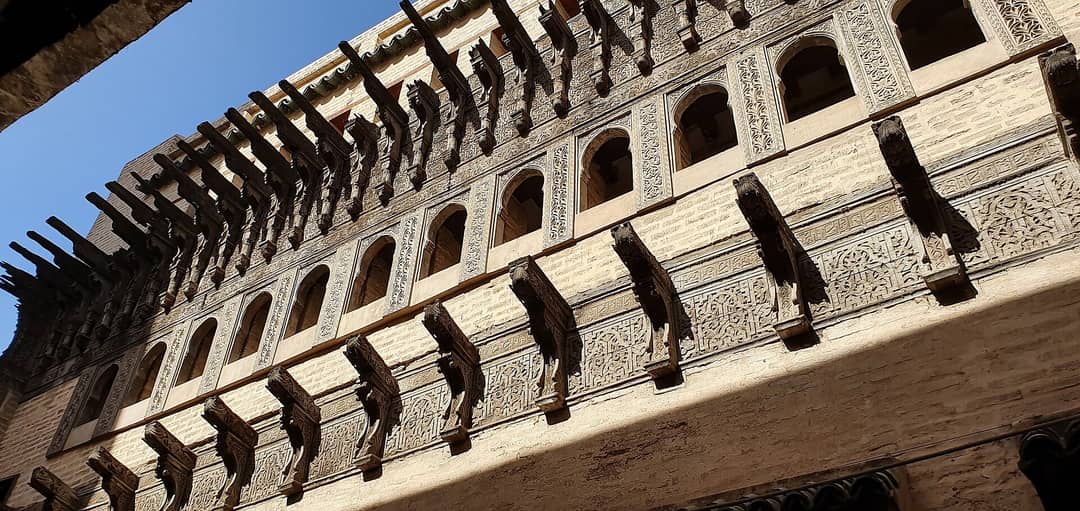
Tradition · Fes el-Bali
House of Maimonides in Fes: The Tradition
Moses Maimonides, the Rambam, lived in Fes for about five years in the 1160s, and a popular tradition places his house on the Tala’a Kebira, opposite the Bou Inania Madrasa, beside a famous medieval water clock. His stay in Fes is accepted history; which house he lived in is not documented. It makes a thoughtful stop on a walk through the old medina, seen from the street.
Maimonides in Fes
Rabbi Moses ben Maimon, known as Maimonides or the Rambam, was born in Córdoba in 1138. After the Almohads conquered the city in 1148 and offered non-Muslims a choice of conversion, exile or death, his family left. According to the Stanford Encyclopedia of Philosophy they reached Fes in 1160; another source gives his years in the city as 1159 to 1165.
In Fes he continued his studies. In these years of wandering he began his Commentary on the Mishnah, which he finished in Egypt in 1168. The family left Morocco around the time of the Almohad persecutions; by 1166 Maimonides was in Egypt, where he settled in Fustat, completed the Guide of the Perplexed in 1190 and died in 1204.
What the tradition says
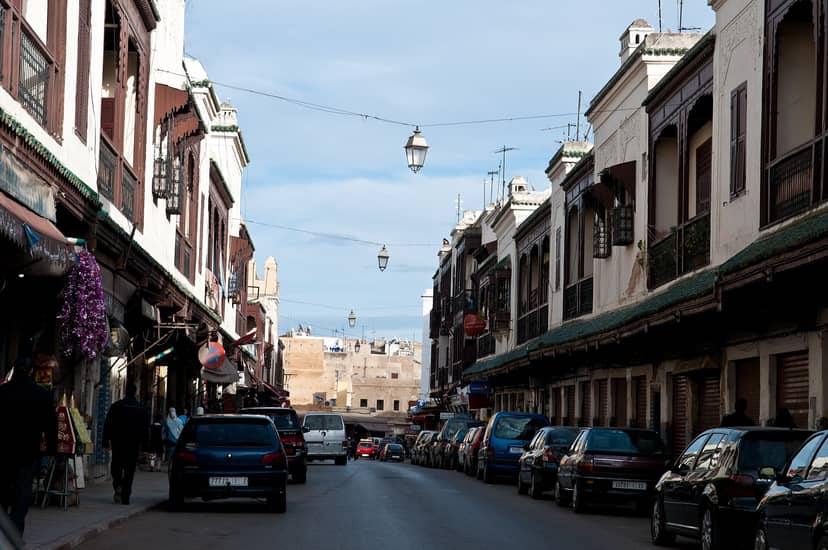
Tradition holds that he lived on the Tala’a Kebira, the main street of the old city, across from the Bou Inania Madrasa. The building most often named is Dar al-Magana, the house of the water clock, which Wikipedia notes is sometimes called the House of Maimonides because of a popular legend. A 2011 visitor report also describes a small marble plaque marking “the house of Maimonides” on Derb Margana, a lane just off the Tala’a Kebira near Café Clock. Sources do not make clear whether the plaque and the water-clock house are the same building.
Two historical points are worth keeping in mind. The water clock was built for the Marinid sultan Abu Inan and completed on 6 May 1357, about 150 years after Maimonides’ death, so the building you see is not the one he knew. And in the 1160s there was no mellah: Fes el-Jdid was only founded in 1276, and Jews lived in the old city, mostly around Bab Guissa. So a home in Fes el-Bali is consistent with where Jews lived in his time, even if the exact house cannot be identified.
The water clock
Dar al-Magana was part of the charitable complex around the Bou Inania Madrasa, built by Sultan Abu Inan between 1350 and 1355. The clock was designed by a muwaqqit, a mosque timekeeper, named Abu al-Hassan ibn Ali Ahmed el-Tlemsani, perhaps on the model of an earlier water clock of 1317 at the Qarawiyyin Mosque. Its façade has twelve windows above twelve platforms that once held brass bowls; each hour a door opened and a metal ball dropped into a bowl. The clock has not worked for generations. The bowls were removed in 2004 for a repair attempt managed by ADER-Fès that has not so far succeeded, and the façade and structure were restored in the early 2000s. Look up at the carved wooden rafters and stucco around the windows.
Visiting today
This is a street-side stop: the water-clock façade and the plaque are seen from outside, and the houses are not open to visitors. The Tala’a Kebira is a busy main street, so stop to one side. Most travellers see it on a guided walk that also takes in the Bou Inania Madrasa and explains where Jews lived in Fes before the mellah. Our Fes Jewish heritage guide links it with the mellah and its synagogues.
House of Maimonides, Fes: questions travellers ask
Did Maimonides really live in Fes?
Yes. Mainstream scholarship accepts that his family lived in Fes in the early 1160s before he moved to Egypt.
Is this really Maimonides’ house?
It is a tradition. No document identifies his house, and the water-clock building dates from 1357, long after his death.
Can I go inside?
No. The façade and plaque are seen from the street.
Where is it?
On the Tala’a Kebira in Fes el-Bali, opposite the Bou Inania Madrasa; the plaque is on Derb Margana, a lane just off the main street.
Sources. Stanford Encyclopedia of Philosophy; Wikipedia (Dar al-Magana; Bou Inania Madrasa; Mellah of Fez); Jewish Virtual Library; Visiting Jewish Morocco; Riad Zany blog (2011). Researched and fact-checked by Gateway2Morocco, October 2026. Access to religious sites changes; we confirm every visit when we plan your trip.