How the community began
Jews are recorded in Demnate from the early 12th century. In the 16th century Leo Africanus found many Jews among the town’s 2,000 households. The community farmed and made wine, which the Jewish Virtual Library calls some of the best in Morocco, and its craftsmen were known for leather goods.
Relations with Amazigh neighbours were generally good, but the 19th century brought violence. Sources date an anti-Jewish attack to 1854, 1864 or 1894; they may describe different events. In 1884–85 the local governor forced Jews to work unpaid and hand over goods. After teachers of the Alliance Israélite Universelle (AIU, the French Jewish school network) raised the alarm, Sultan Hassan I issued two decrees ordering the abuses to stop.
The mellah
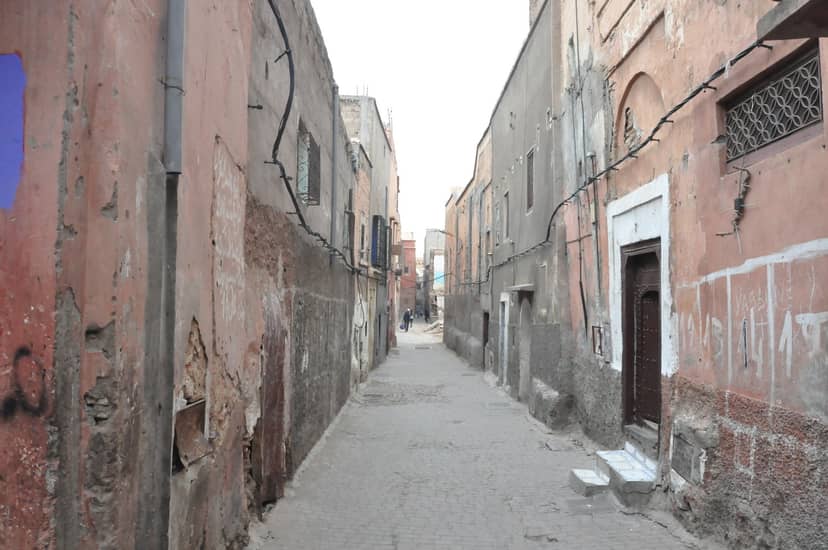
The walled Jewish quarter, the mellah, was built in the 19th century; one source dates it to 1887. Population figures vary by source and year: 1,700 Jews out of 4,000 inhabitants in 1883; about a third of the town’s 3,000 people in the 1940s; about 1,800 Jews in the early 1950s; and still almost a fifth of the town’s population in 1960.
An AIU school opened in 1932. Under the Glaoui caids of the French Protectorate period, Jews were reportedly treated with respect. Departures for Israel accelerated from the mid-1950s, and by the early 1960s only a few Jews remained. In 2011 a single Jewish woman still lived in the town; today there is no Jewish population.
For anyone tracing Demnate roots, Pierre Flamand’s 1952 study Un mellah en pays berbère: Demnate is the classic description of the community.
Walking the mellah today
The quarter is public and lived in. Its residents are tailors, seamstresses and merchants, working from houses and shops that a 2011 report described as little changed since the Jewish families left.
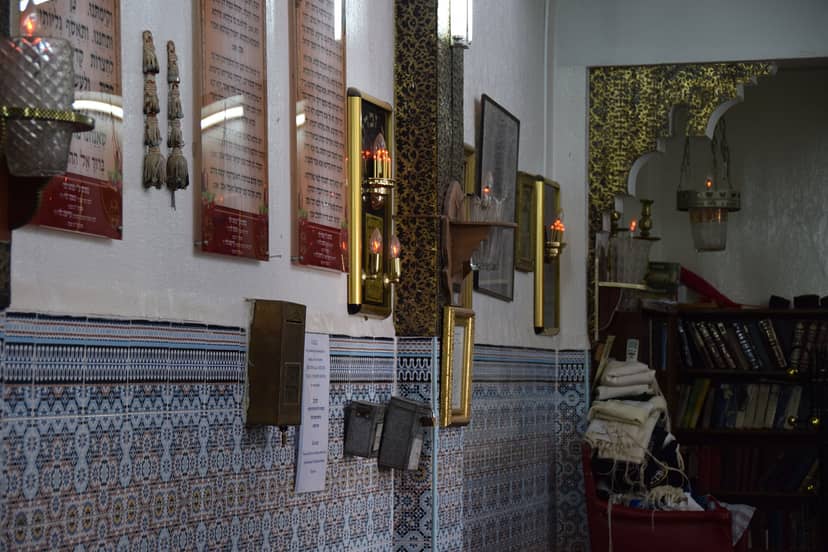
The Ben Hakkou synagogue overlooks the mellah entrance. Before leaving, the community sold it to a Muslim buyer, who turned it into a mosque without altering the building. As a mosque it is generally not open to non-Muslim visitors, but you can see it from the street.
The area also has Sidi Mhasser, a sanctuary once shared by Jews and Muslims, which gave its name to the river. Women hoping for children went there for baraka (blessing): Jewish women on Saturdays, Muslim women on Fridays.
Beyond the mellah
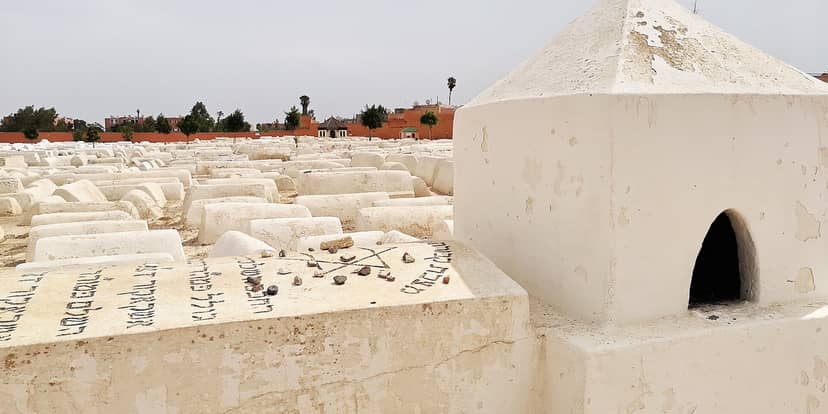
The Jewish cemetery at Tighermine, near the town, was reported intact in 2011. In October 2025 the Ministry of Culture announced that Dar Moulay Hachem, beside a recently renovated Jewish cemetery, will become a centre for Jewish heritage. The tomb of Rabbi David Halevi Dra’a, a pilgrimage site, is at the village of Draa close by. Demnate is a long day from Marrakech; we usually suggest an overnight so you can see all three without rushing. Our southern Morocco guide has more on the region.
Mellah of Demnate: questions travellers ask
How far is Demnate from Marrakech?
About 110 km east. It can be done as a long day trip, but an overnight gives time for the mellah, the cemetery and the nearby shrine.
Are there still Jews in Demnate?
No. The community left between the mid-1950s and early 1960s; the last Jewish resident reported was a woman still living there in 2011.
Can I go inside the old synagogue?
The Ben Hakkou synagogue was sold and became a mosque, so it is generally closed to non-Muslims. You can see the building from the mellah entrance.
My family came from Demnate. Can you help?
Yes. We can plan a roots visit with a guide who knows the town and ask the Marrakech community about cemetery access; see our roots trip guide, though we cannot promise records survive.
Sources. Jewish Virtual Library; La Vie éco (2011); Visiting Jewish Morocco (moroccanjews.org); Morocco World News (2025). Researched and fact-checked by Gateway2Morocco, October 2026. Access to religious sites changes; we confirm every visit when we plan your trip.