Who he was
Rabbi David ou Moshe was born in Jerusalem; his birth date is not known. Accounts differ on his family, some describing his parents as Ashkenazi and others as Moroccan Jews living at Talpiot, near Jerusalem. A story told by his devotees says his father, a wealthy and generous man without other children, dreamed that he would have a tzaddik (righteous holy man) son named after King David and Moshe Rabbenu, Moses. Locals also call him David Ben Moshe or David Vemoshe.
He was sent to Morocco as an emissary to raise money for the poor and to support Jewish schools, entering the country through the port of Melilla with a yeshiva student as his companion. One account places the journey in the period after France took Algeria in 1830.
The legend of Agouim
According to the tradition, when he reached Agouim he found many villagers, Jewish and Muslim alike, sick and dying. He prayed for them and offered his own life in exchange for theirs. The legend says a voice accepted the offer; he washed and put on a white burial shroud brought by angels, a spring gushed from the ground, and he lay down in a grave that two great stones rose to seal. The villagers then gave his companion the funds he had come to collect.
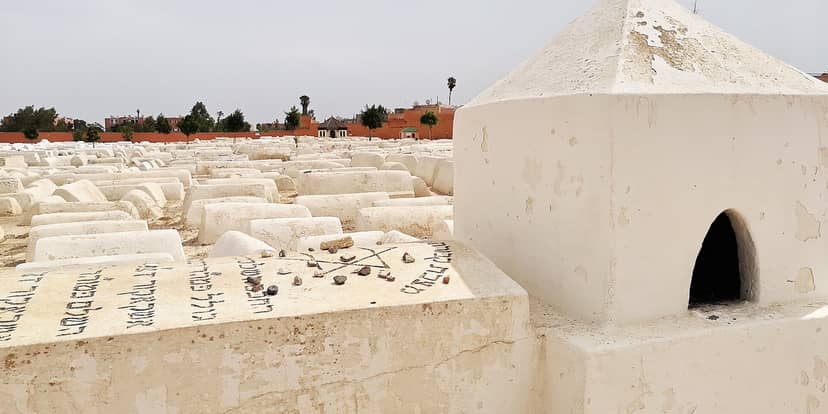
Later stories gather around the tomb. The ethnographer Issachar Ben-Ami recorded that an Amazigh chief (amghar) whose subjects plotted to kill him took refuge at the grave, survived, and afterwards endowed an annual gift in the rabbi’s name. Women leave gold coins on the tomb overnight, believing they absorb the saint’s baraka (blessing), and wear them as necklaces afterwards. Muslims also come every year to honour him.
The hilloula
The hilloula, the annual celebration at a tzaddik’s grave with prayer, candle-lighting and shared meals, is held on 1 Heshvan, the first day of the month of Heshvan and part of Rosh Chodesh (the new-moon festival). Because the Hebrew calendar is lunar, the Gregorian date moves each year between early October and early November: 1 Heshvan was 12 October in 2026 and falls on 1 November in 2027.
Visiting Jewish Morocco shows the tomb among the shrines restored by the Houses of Life programme of cemetery and shrine restorations. Moroccan Jews make the pilgrimage every year, and we can build a High Atlas route around the date. Our hilloula guide explains what to expect.
Visiting outside the pilgrimage
Outside the hilloula the site is quiet, and visits are arranged through the guardian. We have found no visitor report from 2024–26, so we confirm access before every trip and do not promise entry in advance. Dress modestly, cover your head at the tomb, and ask before taking photographs. A small offering for the guardian is customary at Moroccan shrines.
Photographs online labelled with his name do not always show this tomb, as he is also honoured at a memorial shrine outside Morocco. The burial place, and the hilloula pilgrimage in Morocco, are at Agouim.
Getting there
Visiting Jewish Morocco places the tomb at Timzrit, north of Ouarzazate on the Tizi n’Tichka road, near Agouim. It is best visited as part of the crossing of the High Atlas between Marrakech and Ouarzazate, with a private driver who knows the turn-off. Our Jewish Marrakech guide covers the other shrines of the Marrakech region.
Shrine of Rabbi David ou Moshe: questions travellers ask
When is the hilloula of Rabbi David ou Moshe?
On 1 Heshvan in the Hebrew calendar. In 2027 that is 1 November; the Gregorian date changes every year.
Can I visit outside the hilloula?
Yes, through the guardian, by arrangement. Recent access reports are scarce, so we confirm before including it.
Can non-Jews visit?
Muslims honour him as well as Jews, and respectful visitors of any background can visit with the guardian’s agreement.
Is there more than one shrine?
He is also honoured at a memorial site outside Morocco, but his tomb and the Moroccan pilgrimage are at Agouim. Check that photos you find online show the Agouim tomb.
Sources. Yabiladi (2019, citing Issachar Ben-Ami); Visiting Jewish Morocco. Researched and fact-checked by Gateway2Morocco, October 2026. Access to religious sites changes; we confirm every visit when we plan your trip.