
Who he was
Rabbi Haim is often overshadowed by his father, Rabbi Amram Ben Diwan, whose grave at Asjen near Ouazzane draws one of Morocco’s best-known Lag BaOmer pilgrimages. According to tradition, father and son came to Morocco from the Land of Israel in the 18th century to raise funds for yeshivot (Torah academies); one account says they came from Hebron, another from Jerusalem. They settled for a time in Fes.
A story told about the family holds that when Haim fell gravely ill as a young man, Amram prayed to give his own life in exchange for his son’s, and Haim recovered. Later, without his father but with three disciples, Haim travelled into the High Atlas to continue the mission.
He is venerated as a tzaddik (a righteous holy man). Traditionally the poor, the sick and childless women come to pray at his grave.
Legends of the tomb
The accounts of his death are tradition, not documented history. One holds that mountain men pursued him on his way south, that he hid in a cave, and that he was never found. Another, recorded by J. D. Semach, tells that villagers once tore down the grave and threw its stones into a ravine, and that by the next morning the tomb stood again in its exact place; after that, the story goes, the villagers venerated him as Moul Enraze, the master of Anraz. A third says that rocks break away from the mountain to cover and protect the tomb.
The shrine
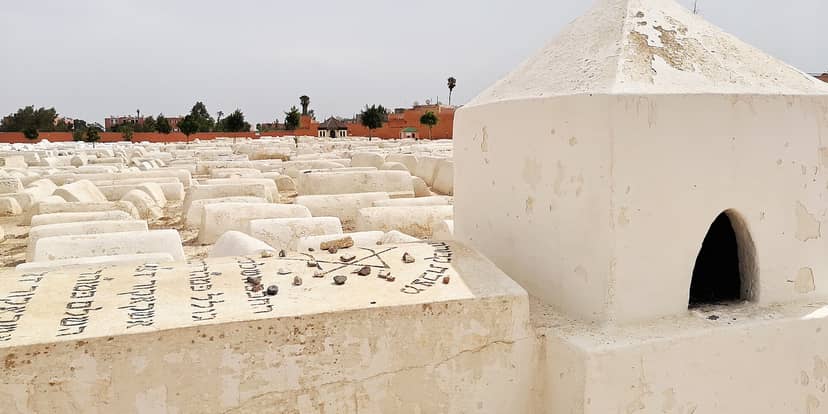
The shrine is a compound of buildings behind a gate, on rocky ground ringed by mountains. Inside are three tombs. Markings on two of them suggest one may be Rabbi Haim’s; the others are believed to belong to disciples. Yabiladi names two other saints buried in the mausoleum, Rabbi Mordekhai and Rabbi Abraham Ben Hammou. A synagogue was built later for pilgrims.
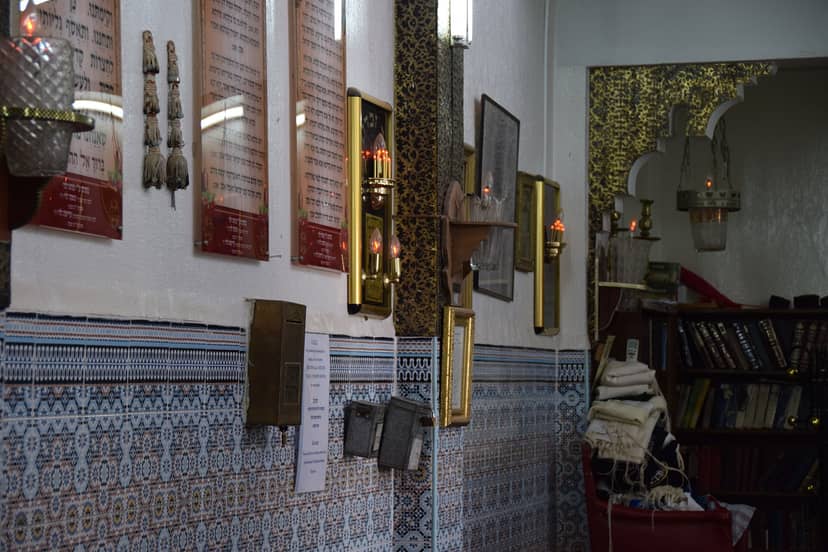
Diarna’s survey recorded candlesticks, menorahs, Torah crowns and a plate engraved with the Ten Commandments in Hebrew in the tomb room, some dating to at least the 1700s. Its description is not recent, so what is on display today may differ.
The hilloula
Moroccan Jews visit through the year, and especially around Lag BaOmer (18 Iyar, the 33rd day of the Omer count between Passover and Shavuot, usually in May), when the hilloula, the annual celebration at the tzaddik’s grave, brings families from Morocco and abroad to Ouirgane. If you want to be there, or to avoid the crowds, we plan the route around it; our hilloula guide explains how.
Getting there
Ouirgane lies on the Tizi n’Test road into the High Atlas, an easy day trip from Marrakech. Pilgrims go to the village of Anraz (also spelled Anrhaz or Anhraz), where a dirt road leads to the compound. Outside the pilgrimage the gate is kept locked, so go with a driver or guide who can arrange for it to be opened.